
 HaBeer
Remember, and Remind
On the preciousness of the source of light, on great kindness, and on how to guard the good we have received.

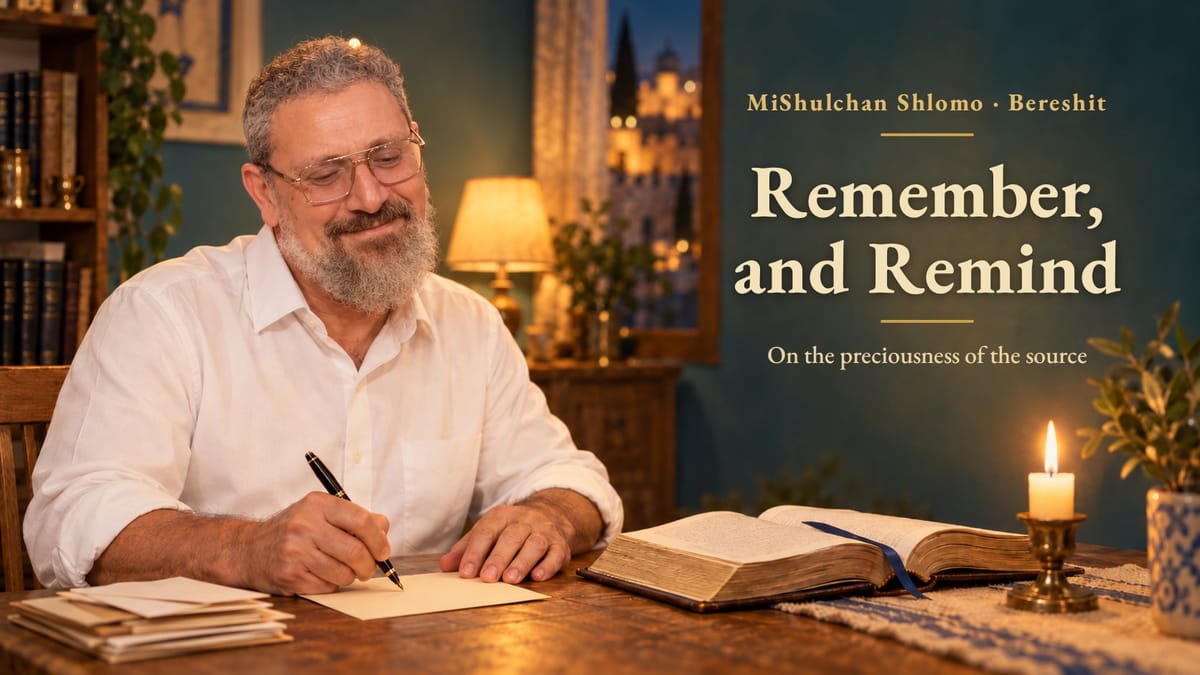
Motzaei Shabbat, 30 Tishrei 5787 (Rosh Chodesh Cheshvan)
From "MiShulchan Shlomo" · Issue 299 · Parshat Bereshit

I was stirred to gather and draw out upright, practical ways of living from the holy writings "MiShulchan Shlomo" (Issue 299, Parshat Bereshit 5787), by our master and teacher the Yanuka, the Gaon Rabbi Shlomo Yehuda shlit"a, a hidden mystery of our generation.
From an immense depth, our Rabbi reveals to us the glory of the Kingship of Hashem precisely through the small things: one small practice, and then another small practice, which reach all the way to the Life of all worlds.
Each time, I will take one point from his words and try to bring it down from learning into action.
This week I wrote an article for Parshat Bereshit.
After it went out, a dear friend gently remarked: "The Rav isn't mentioned."
And then I realized that I had not mentioned, and had not given enough honor and importance to, the source of the light and knowledge I received.
It wasn't intentional. But it was missing.
And precisely that lack, once I understood it, taught me the most important lesson of the week.
🌊 Not wickedness, but forgetting
In the shiur on "Blessed shall you be when you come in," our Rabbi brings the words of our Sages: when the world was created, the Holy One "built worlds and destroyed them."
Why? Because He wished to draw down endless abundance and blessing to His creatures, but He saw that out of the abundance they would come to arrogance.
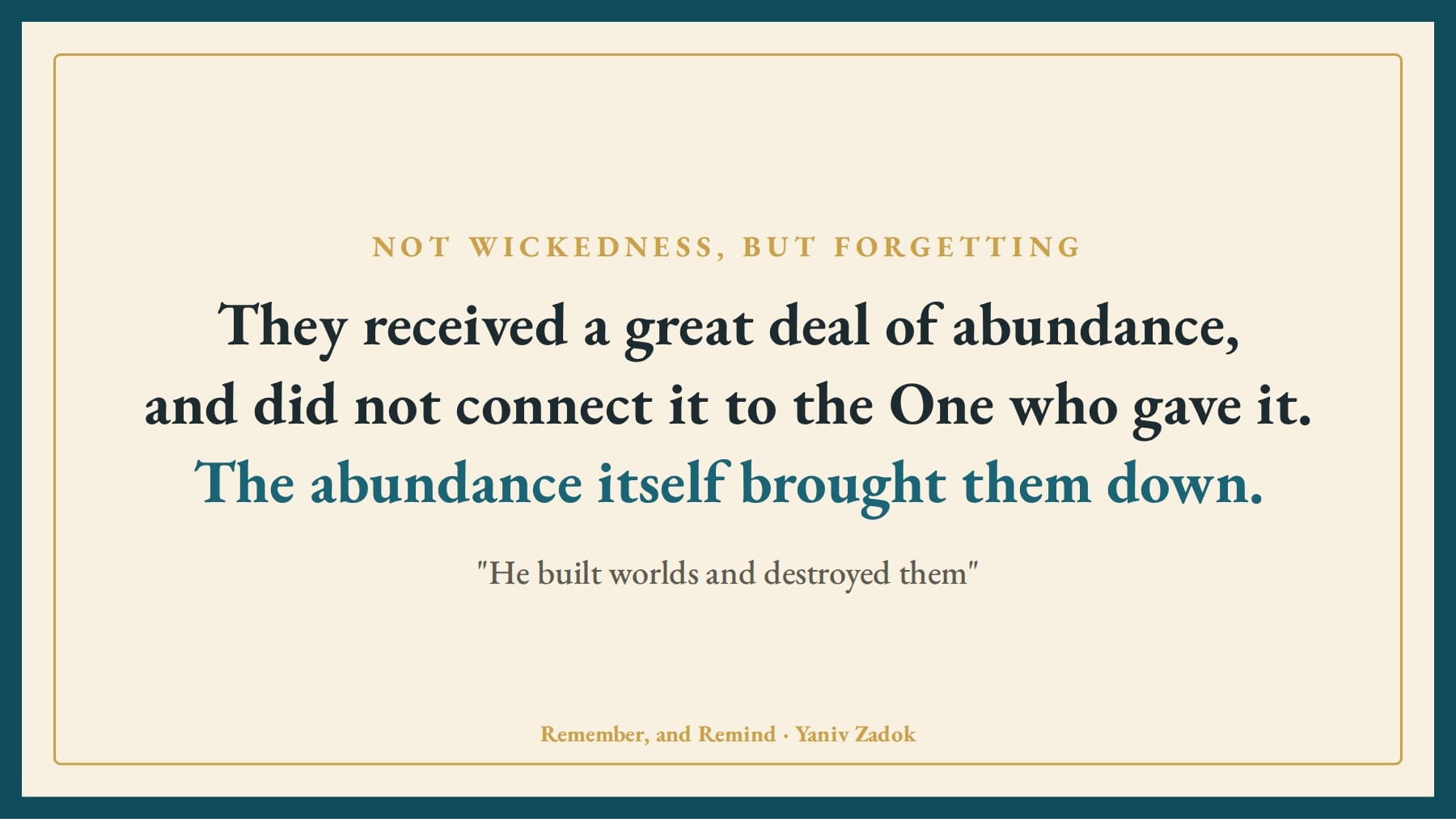
So it was with the generation of the Flood, the generation of the Tower of Babel, and the people of Sodom. They received a great deal of abundance, and out of that abundance they erred, corrupted their ways, and took all the kingship for themselves.
They did not connect the good they received to the One who gave it. And where there is no such connection, there is no protection. The abundance itself brought them down.
And this is what struck me: the fall did not begin with great wickedness. It began with forgetting.
☀️ Precisely when things are good
When things are hard, we remember to ask. When things are good, it is very easy to forget.
The project succeeded, the deal closed, the article came out well. And without noticing, we start to feel it is ours. That we did it.
Our Rabbi writes that because of the force of the harsh judgments that come upon the world, and upon each person individually, "a person forgets His kindnesses, may He be blessed."
Forgetting is not a rare glitch. It is our natural state. So we have to work on it, every single day.
🗣️ To remember, and to remind
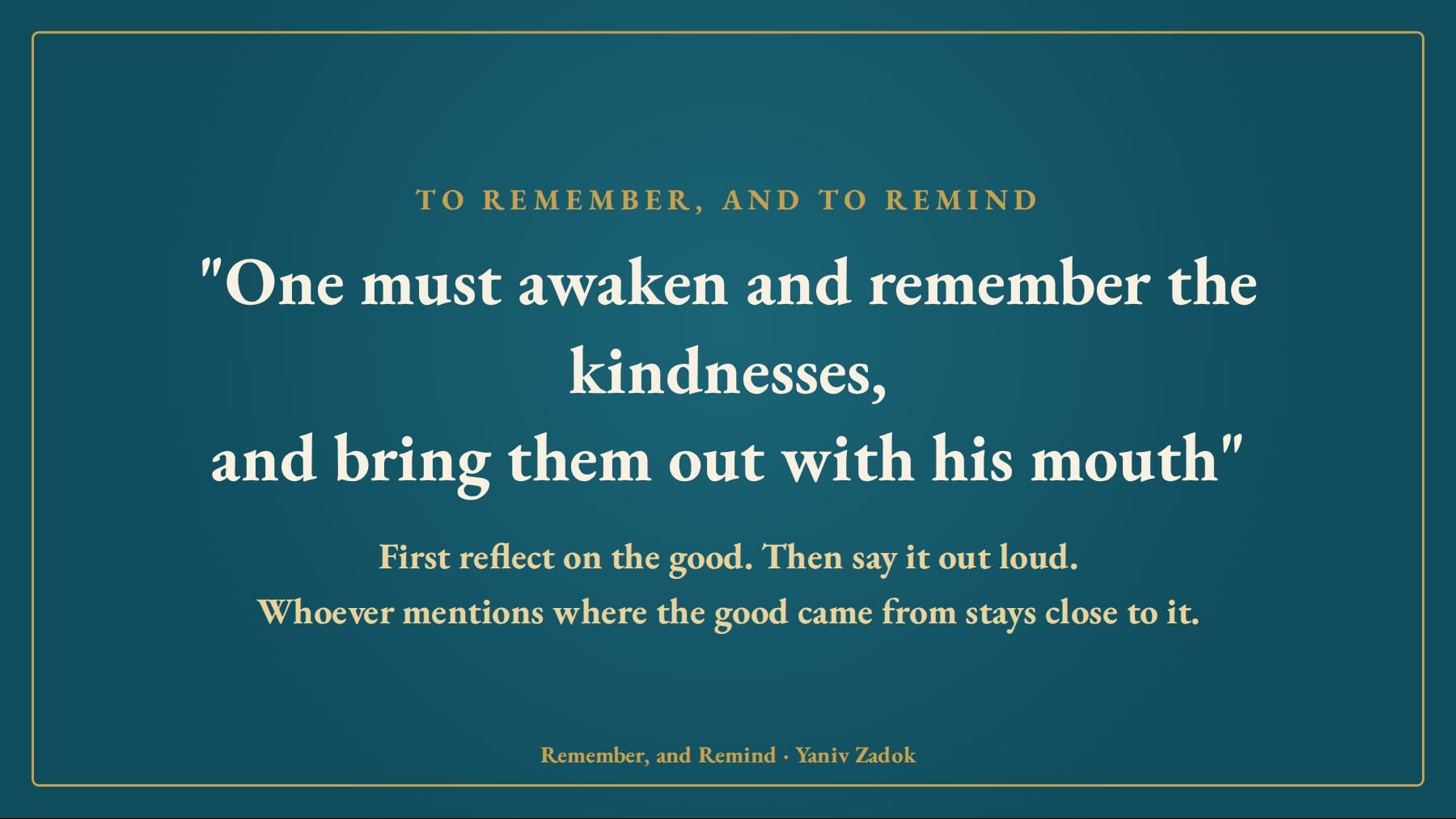
And the remedy, in our Rabbi's words: "One must awaken and remember the kindnesses, and bring them out with his mouth."
Two steps. First, to remember: to stop and reflect on the good I have received. Then, to remind: to say it out loud.
It is not enough to feel gratitude in the heart. As long as it stays inside, it easily fades. When we say it aloud, it becomes real.
Our Rabbi explains that praise and thanksgiving are like a seal on the abundance. They guard it, so it does not lead to arrogance.
Whoever mentions where the good came from stays close to it.
👥 And in our own lives
I think of everyone who brought me to where I am. Teachers, parents, partners, whoever gave me a first chance.
They are all part of the abundance I live in today. And how many times have I really told them so?
And this is even more true before the Holy One. Every morning I wake up, every breath, every small success. It is all kindness.
The question is whether I remember. And whether I also say it.
🧭 Three small habits
- Before you begin, ask: from whom did I receive this? An idea, an opportunity, a tool. Every good thing has a source.
- One thank-you a week, by name and out loud. Choose one person and tell them exactly what you are thankful for. Not "thanks for everything," but one specific thing.
- With every success, mention who helped. In a meeting, in a message, at the Shabbat table. And above all, say "Baruch Hashem," and mean it.

🌱 My own correction
So this week I made a correction. To the previous article I added what should have been there from the start: where these words come from.
And from now on, in every article inspired by our Rabbi's words, the source will appear. Which issue, which parsha, and from whom I received it.
Not because I have to. Because that is the lesson itself.
And a special thank-you to the dear friend who pointed it out. I won't write his name, but he knows: this correction is thanks to him. And that, too, is part of the lesson: to remind others of the one who reminded us.
May we all merit to remember the kindnesses, and to mention them out loud. And may the abundance Hashem gives us stay protected, through blessing and praise.
Shavua tov u'mevorach 🌹
Yaniv
✨ From the Great Light to the Small Deed
I was stirred to gather and draw out upright, practical ways of living from the holy writings "MiShulchan Shlomo," by our master and teacher the Yanuka, the Gaon Rabbi Shlomo Yehuda shlit"a, a hidden mystery of our generation.
Our Rabbi is great beyond measure, and we cannot grasp his greatness. And it is exactly here, in my eyes, that a great wonder lies.
From an immense depth, from the secrets of the Torah and the heights of heaven, he reveals to us the glory of the Kingship of Hashem precisely through the small, simple things of life.
One small practice, and then another small practice. One deed you can do today, and another you can add tomorrow.
What seems far, high and complicated to us, our Rabbi brings close, breaks into small steps, and gently leads us into the service of Hashem within everyday life.
Here, in the kingdom of this earth. At home, in speech, in thought, in how we treat others, and in every simple act.
And those small practices, whose greatness we sometimes barely notice, act and reach all the way to the Life of all worlds.
And from this awakening came the desire to write: each time to take one point from our Rabbi's words, to reflect on it, and to try to bring it down from learning into action.
Not to grasp the depth of his words, but to begin walking in their light.
One small step, and then another small step.
of our master and teacher the Yanuka, the Gaon
Rabbi Shlomo Yehuda shlit"a
Issue 299 · Parshat Bereshit 5787 · 4 pages, in Hebrew, ready to print
Download and print (PDF) ⬇️Send it to someone you want to thank.
Share on WhatsApp 💬 💬 Send me a WhatsApp message · or visit my digital business card