 HaBeer
Entering Anew, Each Time
The Torah begins again from the very beginning, and with it comes an invitation to ask not only what we do, but how we enter into it.


Friday, 28 Tishrei 5787 · Parshat Bereshit · 🕯️ Shabbat candle lighting and ending times

I was stirred to gather and draw out upright, practical ways of living from the holy writings "MiShulchan Shlomo," by our master and teacher the Yanuka, the Gaon Rabbi Shlomo Yehuda shlit"a, a hidden mystery of our generation.
From an immense depth, our Rabbi reveals to us the glory of the Kingship of Hashem precisely through the small things: one small practice, and then another small practice, which reach all the way to the Life of all worlds.
Each time, I will take one point from his words and try to bring it down from learning into action.
After a full month of holidays, we all return.
We return to the desk, to the computer, to our clients, to the lists that waited so patiently for us to come down from the Sukkah.
And on this very Shabbat, in the very same week, the Torah returns as well. We begin once again with "Bereshit", "In the beginning".
There is something moving in this. And there is also a question, which I would like to ask of you, and of myself.
🚪 How many times a day do we enter?
We are used to thinking that there is only one beginning. Rosh Hashanah, the start of a new project, the first day at a new job.
But if we stop and look at an ordinary day, we discover that we are entering all the time.
We enter a meeting. We enter our home in the evening. We enter into prayer after an hour on the telephone. We return to a task after someone has interrupted us.
Every such return is an entering anew. And the question is not whether we entered. The question is how.
For one may enter as someone who simply carries on from where he stopped, tired, his mind still on the previous matter. Or one may enter as though entering for the very first time.
✨ The Torah chose to open with a blessing

Our sages noticed a small detail. The Torah does not open with the first letter of the Aleph-Bet. It opens with the letter Bet, "Bereshit".
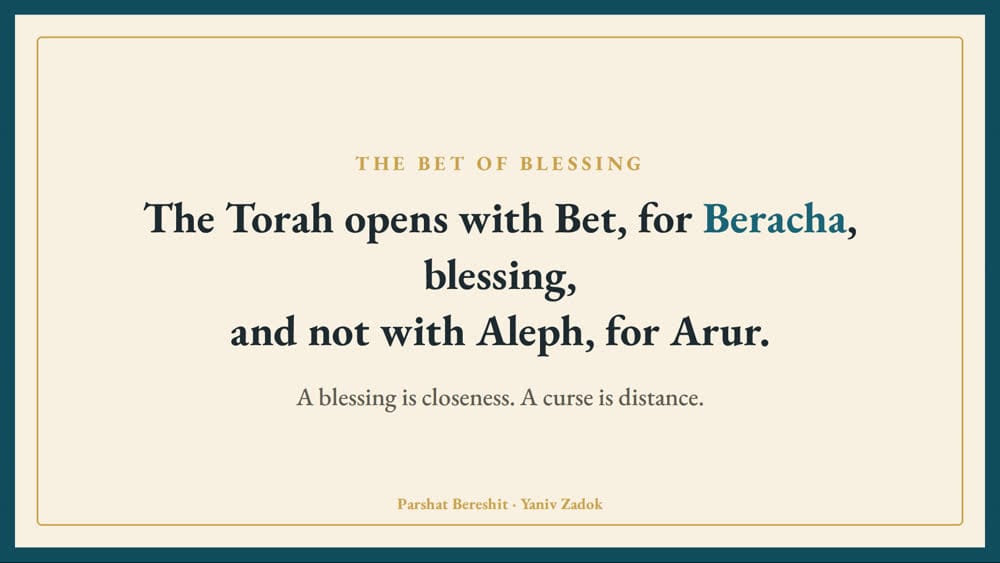
And one of their explanations is simple and beautiful: Bet is the letter of Beracha, blessing, while Aleph is the letter that opens the word Arur, cursed.
The whole Torah, the whole world, opens with a blessing.
I do not know about you, but for me this put things in order. If creation itself began with a blessing, then every small entrance of mine also holds a choice: from which side do I enter?
From blessing, or from "here we go again".
A blessing, in my eyes, is first of all closeness. To enter with a blessing is to enter close: close to people, close to the work, close to the Holy One. And what pushes us away almost always begins with a weary entrance.
🎶 Praise, not lament
And we learn more from this portion.
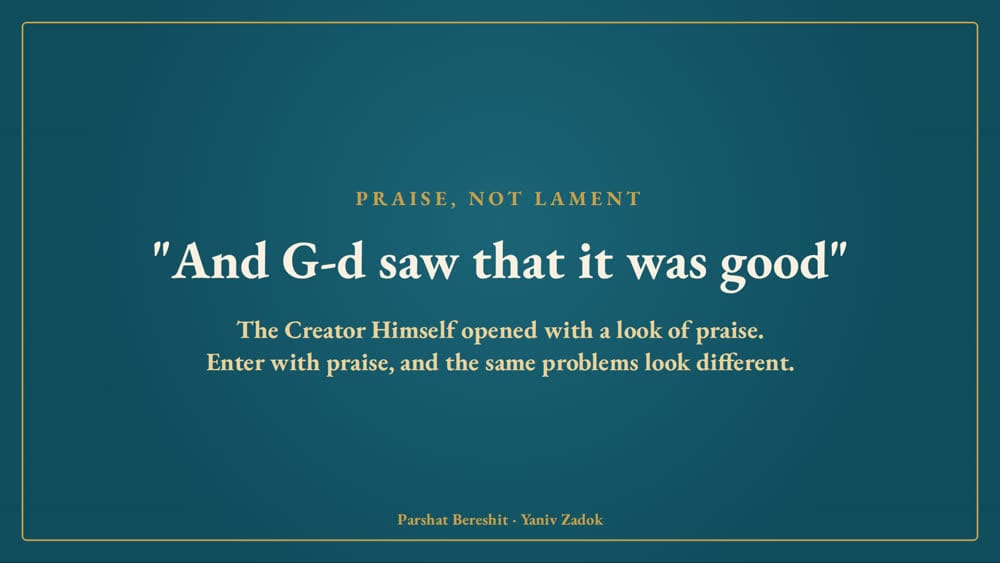
The Holy One looks upon what He has created and says, "It is good". Again and again. And at the end, "very good".
That is to say, the Creator Himself opens with a look of praise.
And what of us? How many times have we entered a day with a list of complaints prepared in advance? What is not working, who did not answer, what is still stuck.
These complaints are not always untrue. But when we enter through them, they set the tone for everything that follows.
When we enter with Hallel, with praise, something changes. The very same problems look different. Suddenly there is strength to deal with them.
🏢 At work as well, and perhaps there most of all
I work a great deal with management teams, and I see this again and again.
The same team, the same people, the same tasks. And yet there is a morning when everything flows, and a morning when everything gets stuck.
The difference is almost never found in the work plan. It is found in the first minute of the meeting.
A manager who enters the morning meeting with "what didn't you do" receives a team that defends itself. A manager who enters with "look at what we have already achieved" receives a team that is ready to hear even what is not working.
This is not a management technique. It is the very same Bet of Bereshit, in its Monday morning edition.
And it is just as true when there is no team. When it is only me, the computer and the list. The first entrance of the day decides far more than we imagine.
🧭 What this means in practice
I do not believe in grand advice. I believe in small habits, the kind one can begin tomorrow morning without announcing it to anyone.
- One moment at the door. Before every important entrance, a meeting, a conversation, coming home in the evening, pause for a second and ask: from which side am I entering now?
- One sentence of praise before the list. Before opening the to-do list, write or say one good thing that is already there. One is enough.
- A new beginning, even in the middle of the day. If I entered crookedly, I may enter again. "Bereshit" does not happen only once a year.

🌱 Adam, not an angel
And the point that strengthens me most of all: the Holy One formed Adam from the earth, and breathed into him a soul from above.
We are not angels. We grow tired, we become confused, we enter crookedly.
But precisely because we are made of both earth and heaven, only we can take the most everyday things, a table, a computer, a conversation with a client, and connect them to something greater than themselves.
And this, so it seems to me, is done one entrance at a time.
Not by one grand decision at the start of the year, but by a small choice, repeated dozens of times a day, at the door.
So this week, as we open the Book of Bereshit in the synagogue, I propose that we all ask one simple question: with which entrance am I entering?
May we all merit a year of good entrances, with blessing and with praise.
Shabbat Shalom U'Mevorach 🌹
Yaniv Zadok
🕯️ Shabbat Times · Parshat Bereshit 5787
 🕯️ Candle lighting
| Jerusalem | 17:38 |
| Bnei Brak | 17:56 |
| Haifa | 17:57 |
| Be'er Sheva | 17:58 |
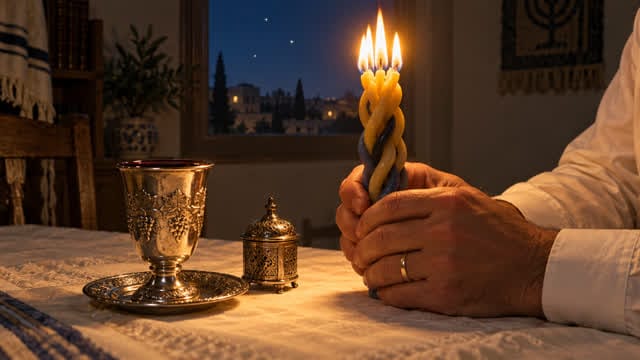 🍷 Shabbat ends · Havdalah
| Shabbat ends | Rabbeinu Tam | |
|---|---|---|
| Jerusalem | 18:48 | 19:29 |
| Bnei Brak | 18:46 | 19:26 |
| Haifa | 18:47 | 19:27 |
| Be'er Sheva | 18:48 | 19:28 |
✨ From the Great Light to the Small Deed
I was stirred to gather and draw out upright, practical ways of living from the holy writings "MiShulchan Shlomo," by our master and teacher the Yanuka, the Gaon Rabbi Shlomo Yehuda shlit"a, a hidden mystery of our generation.
Our Rabbi is great beyond measure, and we cannot grasp his greatness. And it is exactly here, in my eyes, that a great wonder lies.
From an immense depth, from the secrets of the Torah and the heights of heaven, he reveals to us the glory of the Kingship of Hashem precisely through the small, simple things of life.
One small practice, and then another small practice. One deed you can do today, and another you can add tomorrow.
What seems far, high and complicated to us, our Rabbi brings close, breaks into small steps, and gently leads us into the service of Hashem within everyday life.
Here, in the kingdom of this earth. At home, in speech, in thought, in how we treat others, and in every simple act.
And those small practices, whose greatness we sometimes barely notice, act and reach all the way to the Life of all worlds.
And from this awakening came the desire to write: each time to take one point from our Rabbi's words, to reflect on it, and to try to bring it down from learning into action.
Not to grasp the depth of his words, but to begin walking in their light.
One small step, and then another small step.
of our master and teacher the Yanuka, the Gaon
Rabbi Shlomo Yehuda shlit"a
Parshat Bereshit 5787 · 4 pages, in Hebrew, ready to print
Download and print (PDF) ⬇️Send it to a friend who is also returning to routine this week.
Share on WhatsApp 💬 💬 Send me a WhatsApp message · or visit my digital business card