
 HaBeer
When Abundance Feels Like a Flood
On 27 messages on a Sunday morning, on the sigh that sets the tone for a whole week, and on what Shabbat knows about floods.

Friday, 5 Cheshvan 5787
From "MiShulchan Shlomo" · Issue 300 · Parshat Noach

Inspired by the holy writings "MiShulchan Shlomo" (Issue 300, Parshat Noach) by our master and teacher the Yanuka, the Gaon Rabbi Shlomo Yehuda shlit"a, a hidden mystery of our generation.
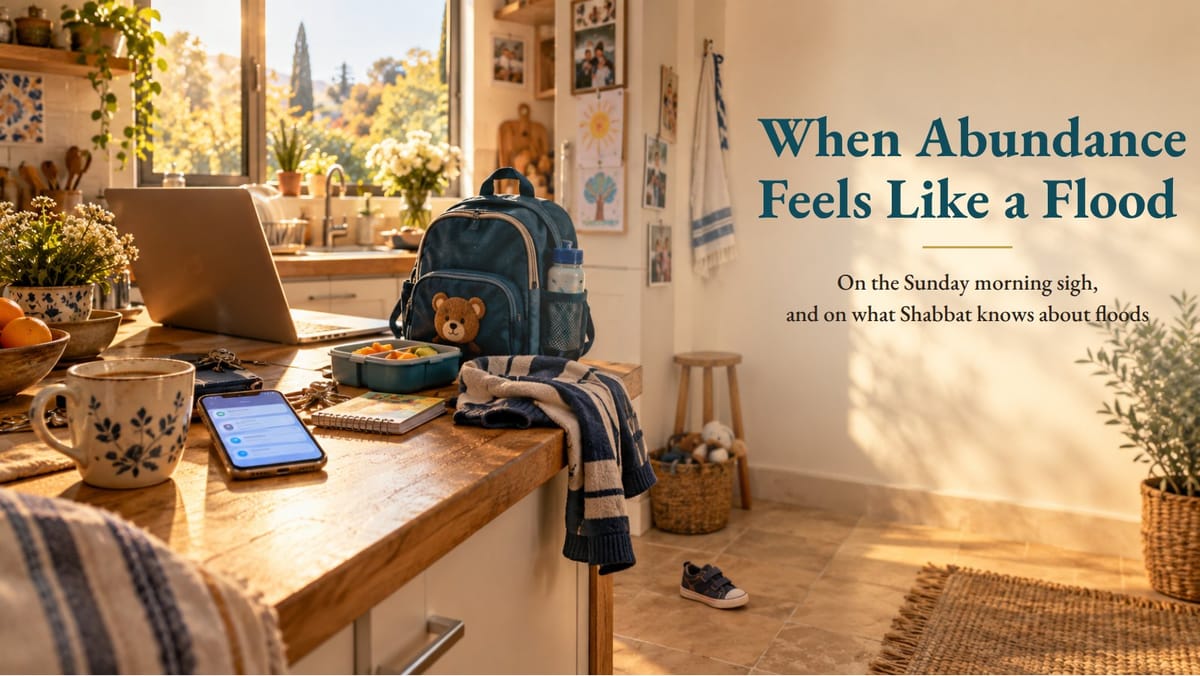
Sunday, ten past seven in the morning. The kids are still looking for one shoe, the coffee is going cold on the counter, and the phone already shows 27 unread messages. A client asks "where does this stand," a supplier says the shipment is delayed, and on the calendar two meetings were booked by mistake for the same hour. And then comes the first sentence of the week: "What a week I have ahead of me." Not a shout and not a crisis. Just a sigh. But that sigh sets the tone for a whole week, before it has even begun. Sound familiar? Almost all of us know it.
🌊 The flood did not start from lack
This Shabbat we read Parshat Noach. A flood, an ark, a world that begins again. And the question worth pausing on for a moment: what was the root of the generation of the Flood? Where did it start? Our Sages say something short and surprising about it: the generation of the Flood grew arrogant only because of the good that the Holy One showered on them. They lacked nothing. They had a lot, maybe too much. And that good came in and stopped there. It did not turn into gratitude, and it did not flow on to anyone else. It turned into arrogance. Water that stands still eventually overflows.
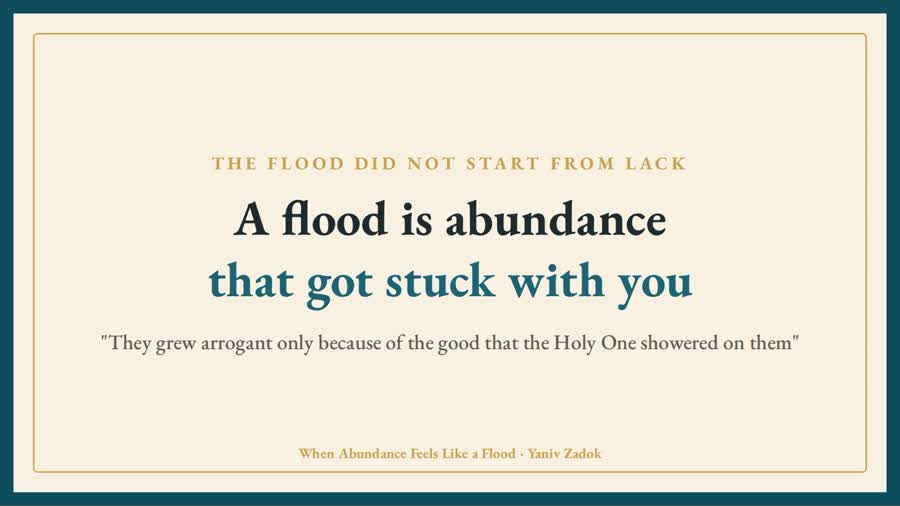
A flood is abundance that got stuck with you.
And if you carry that sentence back to Sunday morning, you see something different. The 27 messages are people who need us. The meetings are work that exists. The lost shoe is a full home. This is not lack, it is exactly abundance. The problem is not how much comes in. The problem is that we received it with a sigh, and instead of flowing, it started to rise.
🚪 Blessed shalt thou be when thou comest in
There are a few words in one verse that sum up the whole matter: "Blessed shalt thou be when thou comest in." A blessing at the entrance. Before we know how the day will end, before the result, already at the door. Because we enter all day long. Into work, into a meeting, into the house in the evening, into prayer after an hour of phone calls. And in every entrance like that there is a small choice: to ask first, or to give thanks first. To walk in with a list of what is missing, or with one word about what is here.
And this is not about forcing yourself to be optimistic. Gratitude does not require saying that everything is fine. It only reminds us that the difficulty is not the whole story. The shipment is still delayed. But someone who walks in with a blessing faces that same shipment differently.
🕯️ The day we do not ask
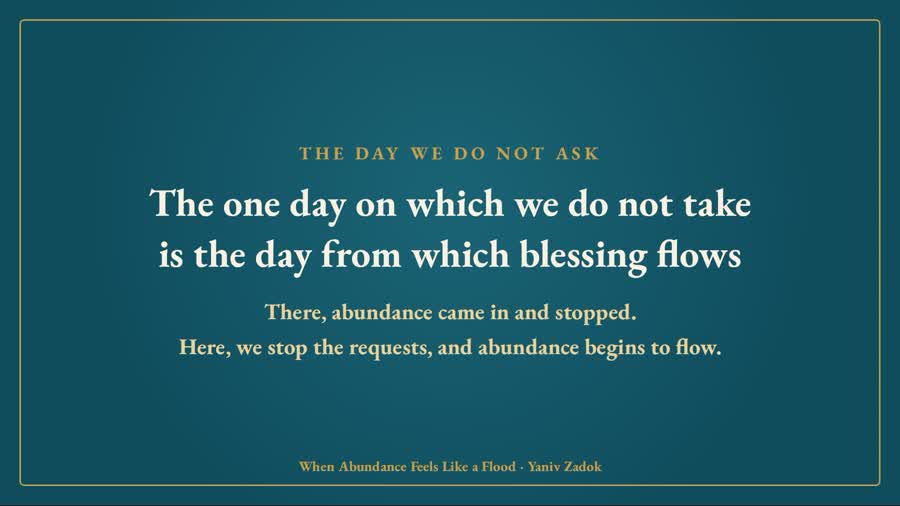
And for this there is an example we all know: Shabbat. Our Sages say that on Shabbat we do not pray over our needs. A whole day without asking. Just giving thanks, offering praise, sitting at the table and being. And it is also said that from this very Shabbat all six days of the week are blessed. Notice what is written here. The one day on which we do not take is the day from which blessing flows to all the others. That is exactly the opposite of the generation of the Flood. There, abundance came in and stopped. Here, we stop the requests, and abundance begins to flow.
Noah did not stop the flood. He built a place the water could not enter. We will not stop the messages and the noise either. But we can build an ark: one day a week, and one minute at every entrance, in which we ask for nothing. We only give thanks.
🌧️ And even when we fall
And there are weeks harder than a sigh. Weeks in which we really do fall. A sharp reply to a client who did not deserve it, a friend who waited for a call and we never got back to him, a promise postponed for the third time. At a moment like that there are two ways to go on. The first is familiar to all of us: to beat ourselves up. "I did it again, I never change." It feels like responsibility. But that crying, when there is no connection in it, actually hardens the heart. And a hardened heart falls again, and cries again, and so on and so on.
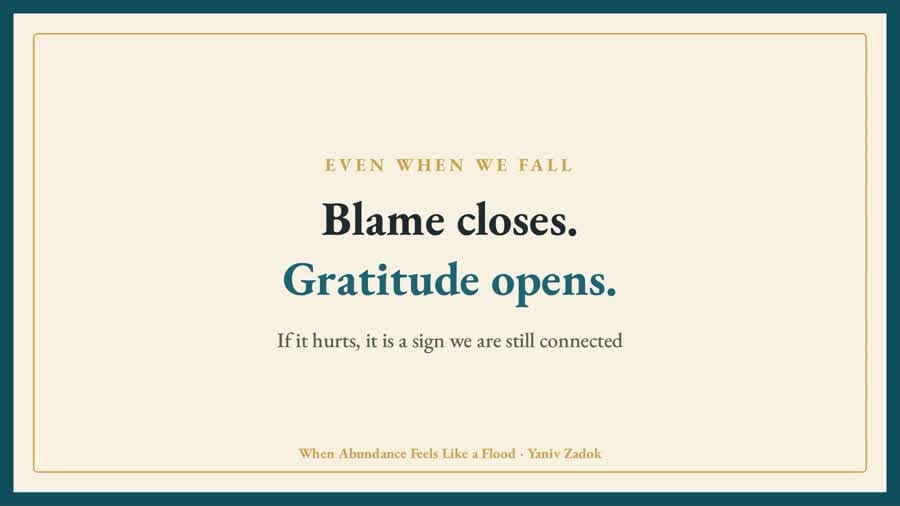
The second way sounds almost the opposite: to find something to be grateful for. Even for the very fact that it hurts us, because there are people who err and feel nothing. If it hurts, it is a sign we are still connected. And from that place the heart softens, and it truly becomes harder to fall again. Here too it is the same matter. Blame closes, gratitude opens. And what is closed eventually overflows.
🚢 Go out of the ark

And one more thing from the parsha, which to me is the heart of the matter. Noah did not leave the ark on his own initiative. He left when he was told: "Go out of the ark, thou, and thy wife, and thy sons, and thy sons' wives with thee." The ark was a rescue, not an address. In the end we open the door, go out, and begin to build a world.
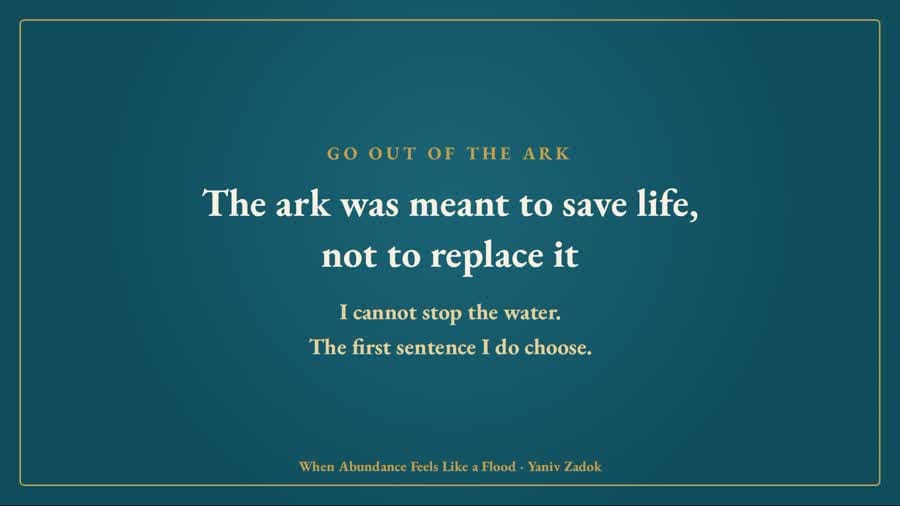
The ark was meant to save life, not to replace it. And Shabbat too is not meant to be kept for ourselves. The quiet we received, the patience, the kind word, were not meant to stay in the ark. They need to flow outward: to the child looking for a shoe, to the colleague at work, to the person in front of us, who has a small flood of his own that he tells no one about. Because what matters is not how nicely we understood. What matters is what we do with it on Sunday.
💧 The first sentence
Next Sunday the small flood will come again. 27 messages, two meetings at the same hour, and a sigh already standing on the tip of the tongue. I cannot stop the water. The first sentence I do choose.
So here is a suggestion for this week, for me and for you: right before you open the computer, right before you answer the first call, one sentence of thanks. For what we have. For the people around us. And even for the fact that we care when we get it wrong. I do not know if I will manage to remember this the next time the phone rings at the worst possible moment. But it seems to me that this is the whole work: not to stop the water, but to let it flow on. It will not change the weather. But it changes the one standing in it.
Shabbat shalom and blessings 🌹
✨ From the Great Light to the Small Deed
I was stirred to gather and draw out upright, practical ways of living from the holy writings "MiShulchan Shlomo," by our master and teacher the Yanuka, the Gaon Rabbi Shlomo Yehuda shlit"a, a hidden mystery of our generation.
Our Rabbi is great beyond measure, and we cannot grasp his greatness. And it is exactly here, in my eyes, that a great wonder lies.
From an immense depth, from the secrets of the Torah and the heights of heaven, he reveals to us the glory of the Kingship of Hashem precisely through the small, simple things of life.
One small practice, and then another small practice. One deed you can do today, and another you can add tomorrow.
What seems far, high and complicated to us, our Rabbi brings close, breaks into small steps, and gently leads us into the service of Hashem within everyday life.
Here, in the kingdom of this earth. At home, in speech, in thought, in how we treat others, and in every simple act.
And those small practices, whose greatness we sometimes barely notice, act and reach all the way to the Life of all worlds.
And from this awakening came the desire to write: each time to take one point from our Rabbi's words, to reflect on it, and to try to bring it down from learning into action.
Not to grasp the depth of his words, but to begin walking in their light.
One small step, and then another small step.
of our master and teacher the Yanuka, the Gaon
Rabbi Shlomo Yehuda shlit"a
Issue 300 · Parshat Noach 5787 · 4 pages, in Hebrew, ready to print
Download and print (PDF) ⬇️Send it to someone whose week started with a small flood.
Share on WhatsApp 💬 💬 Send me a WhatsApp message · or visit my digital business card