 HaBeer
The Quiet That Stays With Us
On the moment after Havdalah, on the quiet that slips away between our hands, and on two words spoken in a single utterance.


Sunday, 7 Cheshvan 5787
From "MiShulchan Shlomo" · Issue 300 · Parshat Noach

Inspired by the holy writings "MiShulchan Shlomo" (Issue 300, Parshat Noach) by our master and teacher the Yanuka, the Gaon Rabbi Shlomo Yehuda shlit"a, a hidden mystery of our generation.
Motzei Shabbat. We make Havdalah, put out the flame in the cup of wine, and say "Shavua tov," have a good week. And then the phone lights up.
Twenty messages. One email that is not pleasant to open. Someone who needs an answer tonight. And within an hour, sometimes less, it is as if Shabbat never happened. The quiet, the conversation at the table, the afternoon nap. All of it gone.
If this sounds familiar, you are not alone. It happens to almost all of us, almost every week. And the question I want to ask this week is a simple one: how do we take Shabbat with us into the week?
🕯️ Two words, one utterance
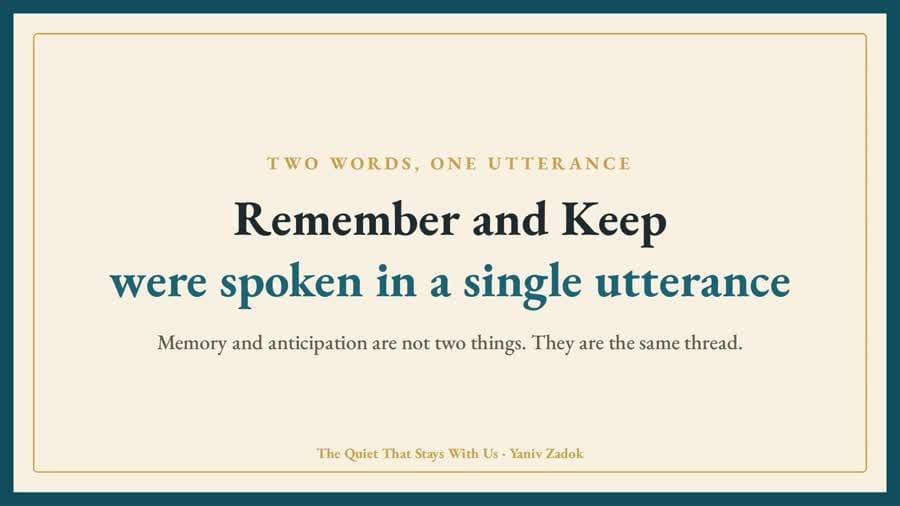
Two words were said about Shabbat. In the Ten Commandments in the Book of Exodus it says "Remember" (zachor): "Remember the sabbath day, to keep it holy." And when they are repeated in the Book of Deuteronomy, it says "Keep" (shamor): "Keep the sabbath day to sanctify it." And our Sages say something remarkable: "Remember" and "Keep" were spoken in a single utterance. Both words came out in one moment, something no human mouth can say and no ear can hear. And on Friday night we sing it in Lecha Dodi: "Shamor ve'zachor be'dibur echad," keep and remember in a single utterance.
"Remember" we all understand. To remember what was. But in "Keep" there is something that is easy to miss. When Joseph tells his father his second dream, it says: "his father kept the matter in mind." And Rashi explains: he waited and watched, wondering when it would come. In other words, "keep" also means waiting for something that has not arrived yet.
And if both were said in a single utterance, memory and anticipation are not two separate things. They are the same thread.
🌉 A bridge, not a wall

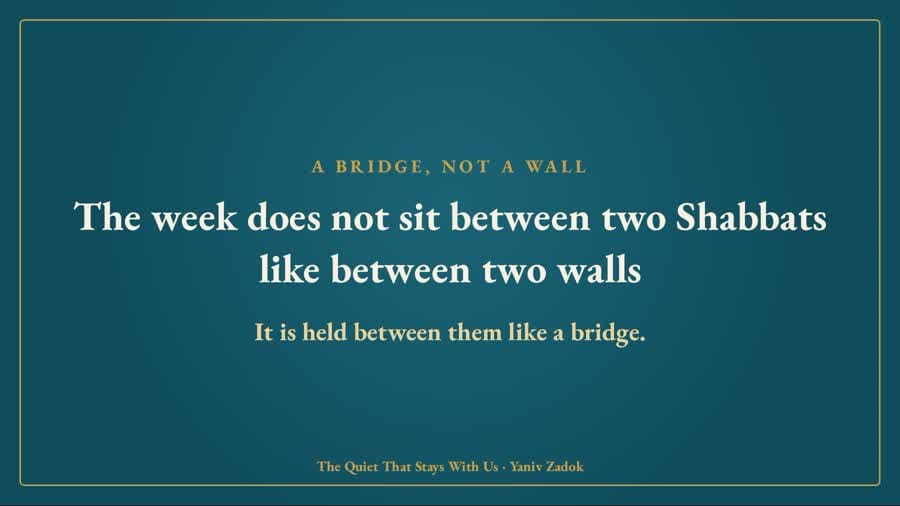
At the start of the week we remember the Shabbat that just passed, and carry something from it forward. At the end of the week we keep, meaning we look forward, to the Shabbat that is coming. And the week is no longer sitting between two Shabbats like between two walls. It is held between them like a bridge.
And to me, this is not true only of Shabbat. Each of us goes through moments of settled calm. A cup of coffee in the morning before everyone wakes up. One prayer that really had focus in it. A long walk. A good conversation with a friend. A few days of vacation. And every time, the same thing: the moment ends, the noise returns, and within an hour it is as if it never was. "Remember and keep" is the way to hold on to those too. To remember what we came from, and to look forward to the next quiet moment.
🐄 "This one is for Shabbat"
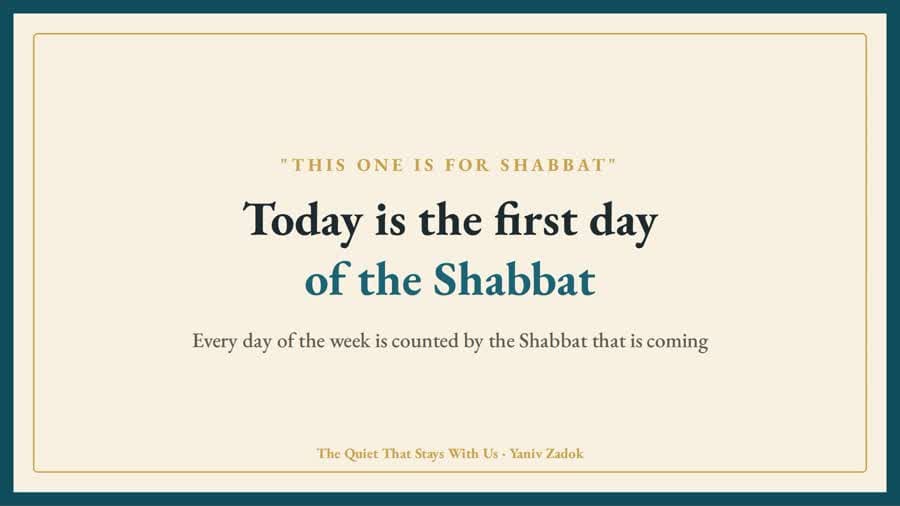
The Talmud tells us about Shammai the Elder that all his days he ate in honor of Shabbat. How? If he found a fine animal on Sunday, he said: "This one is for Shabbat." And if on Tuesday he found a finer one, he set the second aside for Shabbat and ate the first. In other words, his whole week was aimed at Shabbat. Every purchase, every day, one question: what am I keeping for Shabbat? That is "Keep" in the most concrete form there is. And from there, by the way, comes a custom we all follow without noticing. In the daily psalm we do not say "Today is Sunday," but "Today is the first day of the Shabbat." Every day of the week is counted by the Shabbat that is coming.
And Hillel the Elder, his colleague, went another way. He said "Blessed be the Lord, day by day," and lived each day on its own terms, trusting that tomorrow too would be good. Both ways are beautiful. One holds the week through anticipation, and the other holds each day through blessing. And each in his own way, neither let the quiet slip away between their hands.
Tonight, after Havdalah, before you open your phone: ask yourself what one thing from this Shabbat you are taking with you into the week. A sentence spoken at the table, a quiet moment, a child's smile. One is enough.
🎁 A light that is not only for us
And one more thing, which to me is the heart of the matter. It is easy to think of Shabbat as a vacation. A day when I rest, I enjoy, I recharge my batteries. But Shabbat is not only for me. What matters is not how good it was for me, but what I can actually do with that light.
The rest of Shabbat is not the end of the road. It is the fuel. Someone who walks into Sunday calm can calm others too. Someone who received a little patience on Shabbat can pass it on.
🏢 The Sunday meeting
And you can see this best on Sunday morning, in the first meeting of the week. There is a manager who arrives at that first meeting already deep in stress. He read every email on Saturday night, and walks in with a list of problems. And there is a manager who arrives with a little of Shabbat's quiet still on him. The same problems, the same list. But the tone is different. And the tone of the first minute, it seems to me, decides far more than what is written on the agenda.
🌙 Next Motzei Shabbat
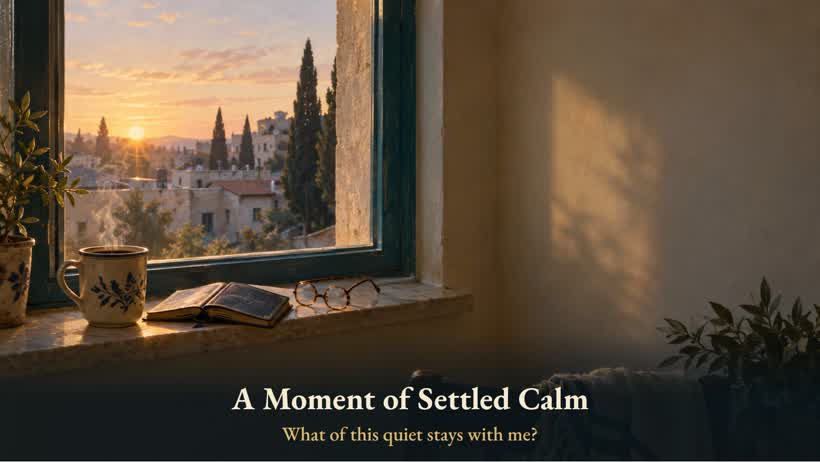
And maybe the next time we make Havdalah, we will notice one small detail in it. Before the candle, we smell the spices. There is something lovely in that. Right as Shabbat leaves, we take a fragrance with us. Something small that cannot be held in the hand, but it stays in the air for a few minutes after the box is closed. That is exactly "Remember." Not trying to hold on to all of Shabbat. Just one fragrance of it, to walk with us into Sunday.
And when Wednesday comes, and the week is already heavy, we can start thinking about the next Shabbat. What will we cook, whom will we invite, which song will we sing. That is "Keep." And between the two, the week passes differently.
🧭 Three small things
- After every moment of quiet: one thing you take with you. On Motzei Shabbat, at the end of a prayer, coming back from a vacation. That is "Remember."
- In the middle of the pressure: one thing you look forward to. The next Shabbat, tomorrow morning's coffee. Knowing the quiet will return. That is "Keep."
- One light for someone else. A kind word, patience, calm. From what you received in the quiet moment.
This week, every time a moment of quiet ends and the messages start rushing in, I suggest pausing for a second and asking: what of this quiet stays with me? And then, slowly, beginning to wait for what is coming.
Have a good and blessed week 🌹
✨ From the Great Light to the Small Deed
I was stirred to gather and draw out upright, practical ways of living from the holy writings "MiShulchan Shlomo," by our master and teacher the Yanuka, the Gaon Rabbi Shlomo Yehuda shlit"a, a hidden mystery of our generation.
Our Rabbi is great beyond measure, and we cannot grasp his greatness. And it is exactly here, in my eyes, that a great wonder lies.
From an immense depth, from the secrets of the Torah and the heights of heaven, he reveals to us the glory of the Kingship of Hashem precisely through the small, simple things of life.
One small practice, and then another small practice. One deed you can do today, and another you can add tomorrow.
What seems far, high and complicated to us, our Rabbi brings close, breaks into small steps, and gently leads us into the service of Hashem within everyday life.
Here, in the kingdom of this earth. At home, in speech, in thought, in how we treat others, and in every simple act.
And those small practices, whose greatness we sometimes barely notice, act and reach all the way to the Life of all worlds.
And from this awakening came the desire to write: each time to take one point from our Rabbi's words, to reflect on it, and to try to bring it down from learning into action.
Not to grasp the depth of his words, but to begin walking in their light.
One small step, and then another small step.
of our master and teacher the Yanuka, the Gaon
Rabbi Shlomo Yehuda shlit"a
Issue 300 · Parshat Noach 5787 · 4 pages, in Hebrew, ready to print
Download and print (PDF) ⬇️Send it to someone whose Shabbat ends too fast.
Share on WhatsApp 💬 💬 Send me a WhatsApp message · or visit my digital business card