 HaBeer
Better to Be Called Simple
On the courage to do what is right, even when it looks strange to others.

Monday, 1 Cheshvan 5787 (Rosh Chodesh Cheshvan)
From "MiShulchan Shlomo" · Issue 299 · Parshat Bereshit

Inspired by the holy writings "MiShulchan Shlomo" (Issue 299, Parshat Bereshit) by our master and teacher the Yanuka, the Gaon Rabbi Shlomo Yehuda shlit"a, a hidden mystery of our generation.
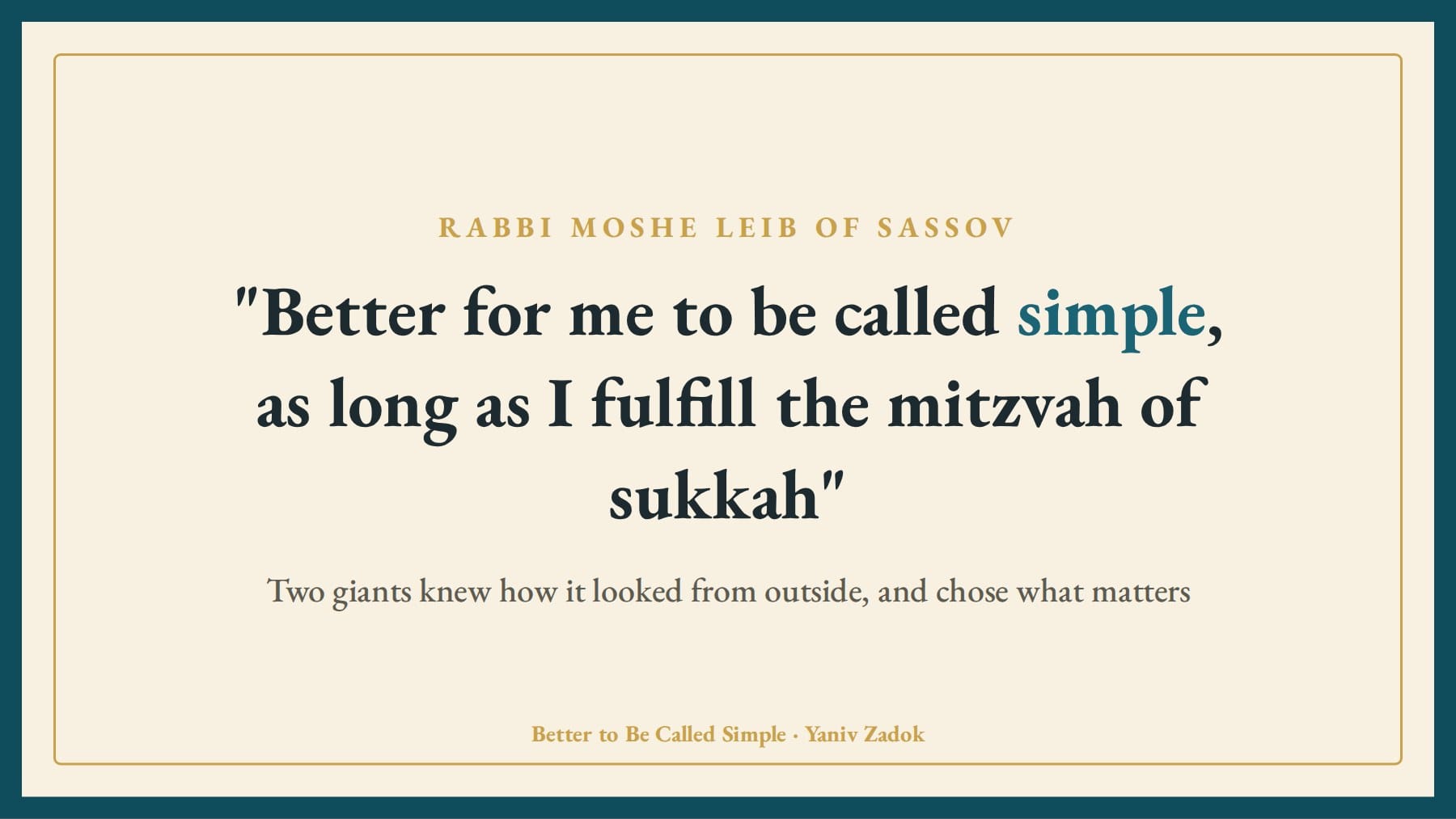
Rabbi Moshe Leib of Sassov would stay in the sukkah even when it rained.
They asked him: But the Rema writes that whoever sits in the sukkah while it is raining is called a "hedyot," a simpleton.
And he answered: Better for me to be called a simpleton, as long as I fulfill the mitzvah of sukkah.
This week's "MiShulchan Shlomo" brought this story.
Think about it for a moment. A great tzaddik, known to the whole town. He knows that whoever sees him sitting in the sukkah in the rain might think he does not know the halacha, or that he is simply stubborn.
And he chooses it anyway. Not because he does not care. Because something else matters to him more.
🪞 The Brisker Rav chose too
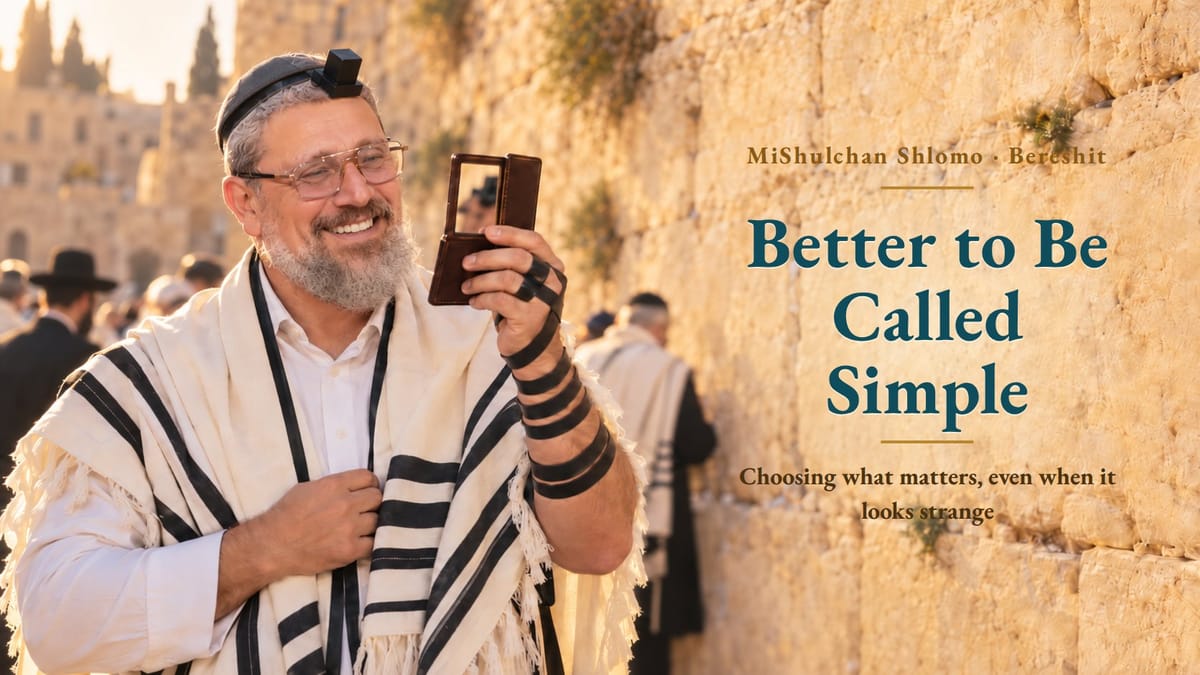
Next to this story, another one was brought. Some people look in a mirror when they put on tefillin, to make sure they sit exactly in place. And there were great rabbis who wrote that this is "a custom of the ignorant."
The Brisker Rav would say: Better for me to look in the mirror and be counted among "the custom of the ignorant," but to fulfill the mitzvah of tefillin with them sitting in their proper place.
Two giants. Both knew exactly how it looked from the outside. And both chose what matters.
And notice: they did not choose what was comfortable. Sitting in the rain is not pleasant, and looking in a mirror while everyone watches is embarrassing. They chose what mattered to them, even when it cost them something.
👀 "What will they say?"
How many times a day do we do something, or not do it, only because of how it will look?
We don't ask a question in a meeting, so as not to look like we didn't understand. We don't admit a mistake, so as not to look weak. We skip Mincha in the middle of a conference, because it is awkward to step out.
"What will they say" is one of the strongest voices inside us. And it almost never asks what is right. It asks what looks good.
We all know the moment. Sitting in a meeting, something is unclear, and we stay silent, because it seems everyone understands except us. And then it turns out no one understood. Everyone was simply afraid to ask.
And it happens at home too. We don't apologize to the children, because "a parent doesn't apologize." We don't ask our spouse for help, because it looks like weakness. We keep going down a path that is already clearly wrong, just so as not to admit we made a mistake.
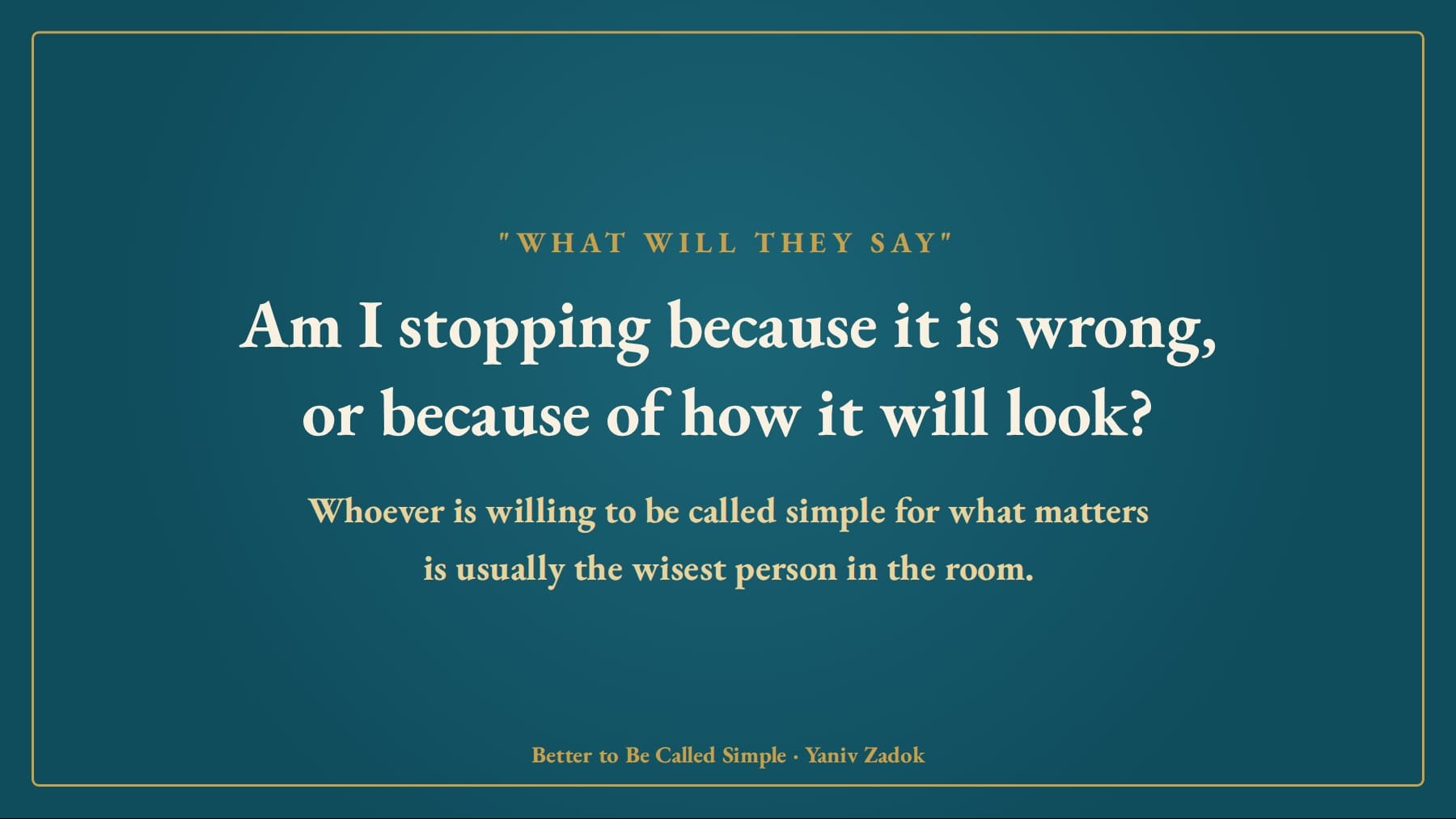
Whoever is willing to be called simple for what matters is usually the wisest person in the room.
Next time "what will they say" stops you, ask: am I stopping because it is wrong, or only because of how it will look? If the answer is the second, do it anyway. Once. Today.

🎯 No rebellion, just what matters
And there is something very beautiful in these stories: there is no rebellion in them. Rabbi Moshe Leib did not belittle the Rema, and the Brisker Rav did not belittle the words of the great rabbis.
They did not say "I don't care what people think." They simply knew what mattered most to them, and were willing to pay the price of looking a little strange.
And that is the difference between stubbornness and what matters. The stubborn person wants to prove he is right. The one who chooses what matters only wants to do what is right.
In business, in management and at home, there are moments when the right thing looks less impressive. Asking for help. Stopping a project that isn't working. Saying "I don't know."
🧭 Another tool: the question of what matters
When we hesitate, we can ask one question: What will remain of this in a year?
The embarrassment of the question in the meeting will be forgotten by evening. The mistake we did not admit will stay with us much longer.
The strange look from someone who saw us step out for Mincha will pass within a minute. The Mincha we prayed will remain.
This question puts "what will they say" at its true size. Very small.
And there is one more thing: almost always, the one who chose what matters ends up earning respect. The employee who asked the question everyone was afraid of is the one people trust. The manager who said "I was wrong" is the one people follow.
What looks for a moment like being simple turns out, over time, to be wisdom.
And in the true accounting, before the Holy One, there is no "what will they say" at all. There is only what I did, and with what heart.
🌧️ The sukkah in the rain

Imagine Rabbi Moshe Leib sitting in the sukkah, with the rain falling on the schach.
From the outside it looks like a mistake. From the inside, it is the joy of someone doing exactly what matters to him.
Because whoever knows what matters to him does not need everyone to understand him.
Chodesh tov u'mevorach 🌹
Yaniv
✨ From the Great Light to the Small Deed
I was stirred to gather and draw out upright, practical ways of living from the holy writings "MiShulchan Shlomo," by our master and teacher the Yanuka, the Gaon Rabbi Shlomo Yehuda shlit"a, a hidden mystery of our generation.
Our Rabbi is great beyond measure, and we cannot grasp his greatness. And it is exactly here, in my eyes, that a great wonder lies.
From an immense depth, from the secrets of the Torah and the heights of heaven, he reveals to us the glory of the Kingship of Hashem precisely through the small, simple things of life.
One small practice, and then another small practice. One deed you can do today, and another you can add tomorrow.
What seems far, high and complicated to us, our Rabbi brings close, breaks into small steps, and gently leads us into the service of Hashem within everyday life.
Here, in the kingdom of this earth. At home, in speech, in thought, in how we treat others, and in every simple act.
And those small practices, whose greatness we sometimes barely notice, act and reach all the way to the Life of all worlds.
And from this awakening came the desire to write: each time to take one point from our Rabbi's words, to reflect on it, and to try to bring it down from learning into action.
Not to grasp the depth of his words, but to begin walking in their light.
One small step, and then another small step.
of our master and teacher the Yanuka, the Gaon
Rabbi Shlomo Yehuda shlit"a
Issue 299 · Parshat Bereshit 5787 · 4 pages, in Hebrew, ready to print
Download and print (PDF) ⬇️Send it to someone who chooses what matters, even when it is not easy.
Share on WhatsApp 💬 💬 Send me a WhatsApp message · or visit my digital business card