
 HaBeer
When I Improve, the World Improves
On quiet influence: how my small correction changes the home, the team and everything around me.


Wednesday, 3 Cheshvan 5787
From "MiShulchan Shlomo" · Issue 299 · Parshat Bereshit

Inspired by the holy writings "MiShulchan Shlomo" (Issue 299, Parshat Bereshit) by our master and teacher the Yanuka, the Gaon Rabbi Shlomo Yehuda shlit"a, a hidden mystery of our generation.
Pinchas ben Yair, one of the great Sages of the Mishnah, had a special donkey. That donkey refused to eat grain from which the tithes had not been separated.
A donkey. An animal. Keeping the laws of tithes.
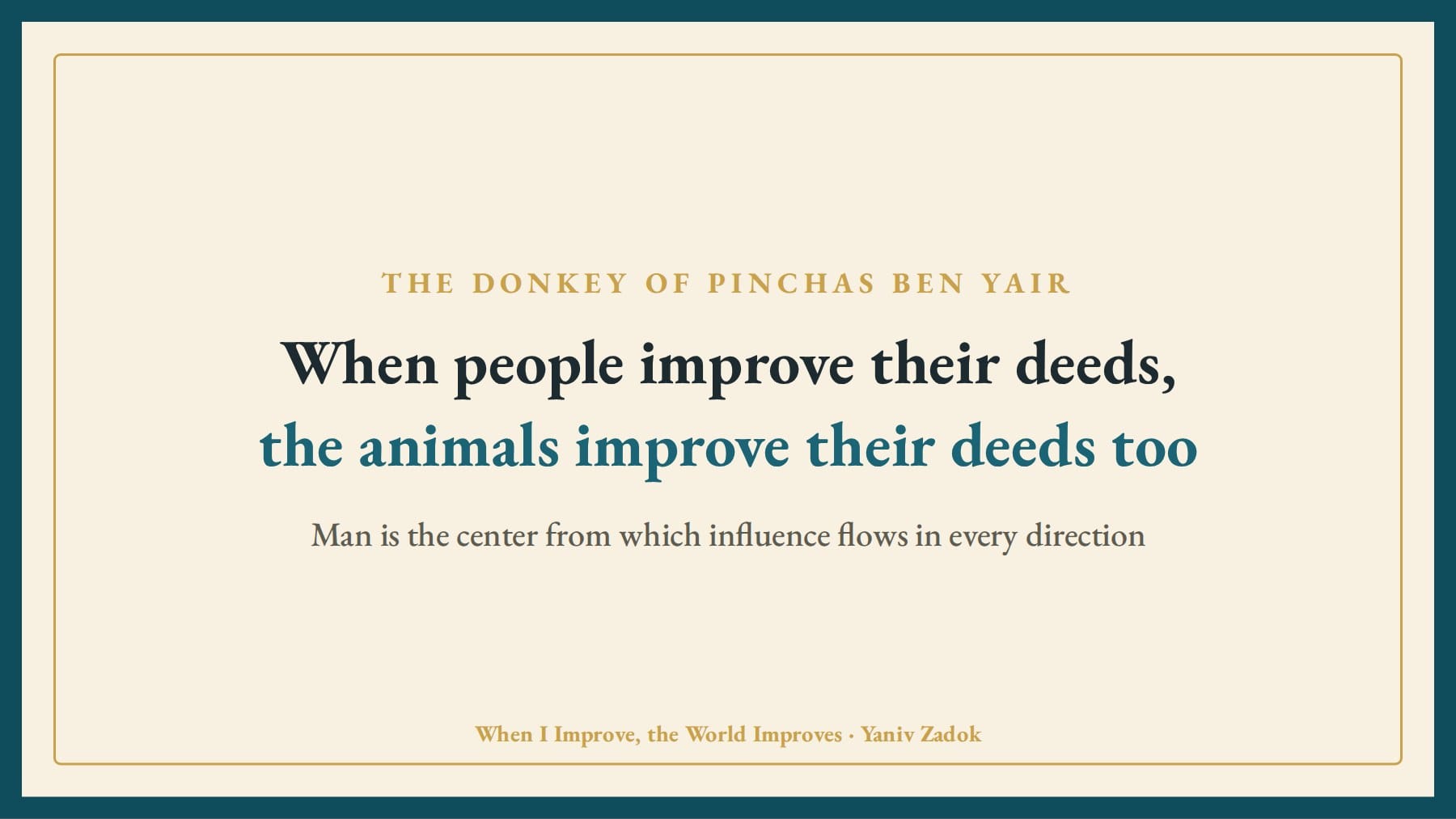
This week's "MiShulchan Shlomo" brings an explanation of this story: when people improve their deeds, the animals improve their deeds too.
The righteousness of Pinchas ben Yair simply seeped through. All the way down to his donkey.
And notice: Pinchas ben Yair did not educate the donkey. He did not lecture it about tithes. He simply was who he was, day after day, in every small detail. And that was enough.
🐎 And the other way around
The Midrash also brings the other side. In the generation of the Flood, when people corrupted their ways, the animals corrupted their ways as well.
And the prophet Isaiah describes the days of the Messiah: "And the lion shall eat straw like the ox... they shall not hurt nor destroy." When man is completely repaired, all of nature will be repaired.
This also explains why the Flood struck all of creation, and not only man. The whole world follows man, for good and for bad.
In other words, man is not just another creature within the world. He is the center from which influence flows in every direction.
🏠 Quiet influence
We all know this from home. When a father comes home calm, the house calms down. When he comes home stressed, within minutes everyone is stressed. No one said a word. The influence simply passed.
Children learn little from what we say, and a lot from what they see. A parent who speaks to their spouse with respect teaches more about respect than any lecture.
And so at work. A manager who arrives with patience finds that the team is more patient. A manager who erupts suddenly finds everyone erupting at everyone.
We are used to thinking that to change others we need to talk to them, convince them, correct them. And sometimes the most powerful way is simply to correct myself, and let the influence do its work.
It is also freeing. I am not responsible for changing everyone. I am responsible for one thing: myself.
Choose one small thing to correct in yourself today, something no one will ask of you: patience in one conversation, a softer tone in the morning, a kind word instead of a remark. And notice what changes around you.
🌍 Man is the channel
And there is another depth. Our Rabbi brings the words of the Gaon of Lissa, who explains that when Adam "called" names to the animals, that calling was a drawing down of abundance from above to below.
Man is the channel. Through him the abundance passes to all creatures.
This gives enormous meaning to every one of our deeds. A good deed of mine is not "just mine." It opens a channel, and abundance passes through it to everyone around me.
And a bad deed, God forbid, closes it. Not only for me, but for everyone who depends on me.
And this is true in small things too. One employee who keeps honest in a small detail, when no one is watching, changes the norm of the whole team over time.
🧭 Another tool: the atmosphere meter
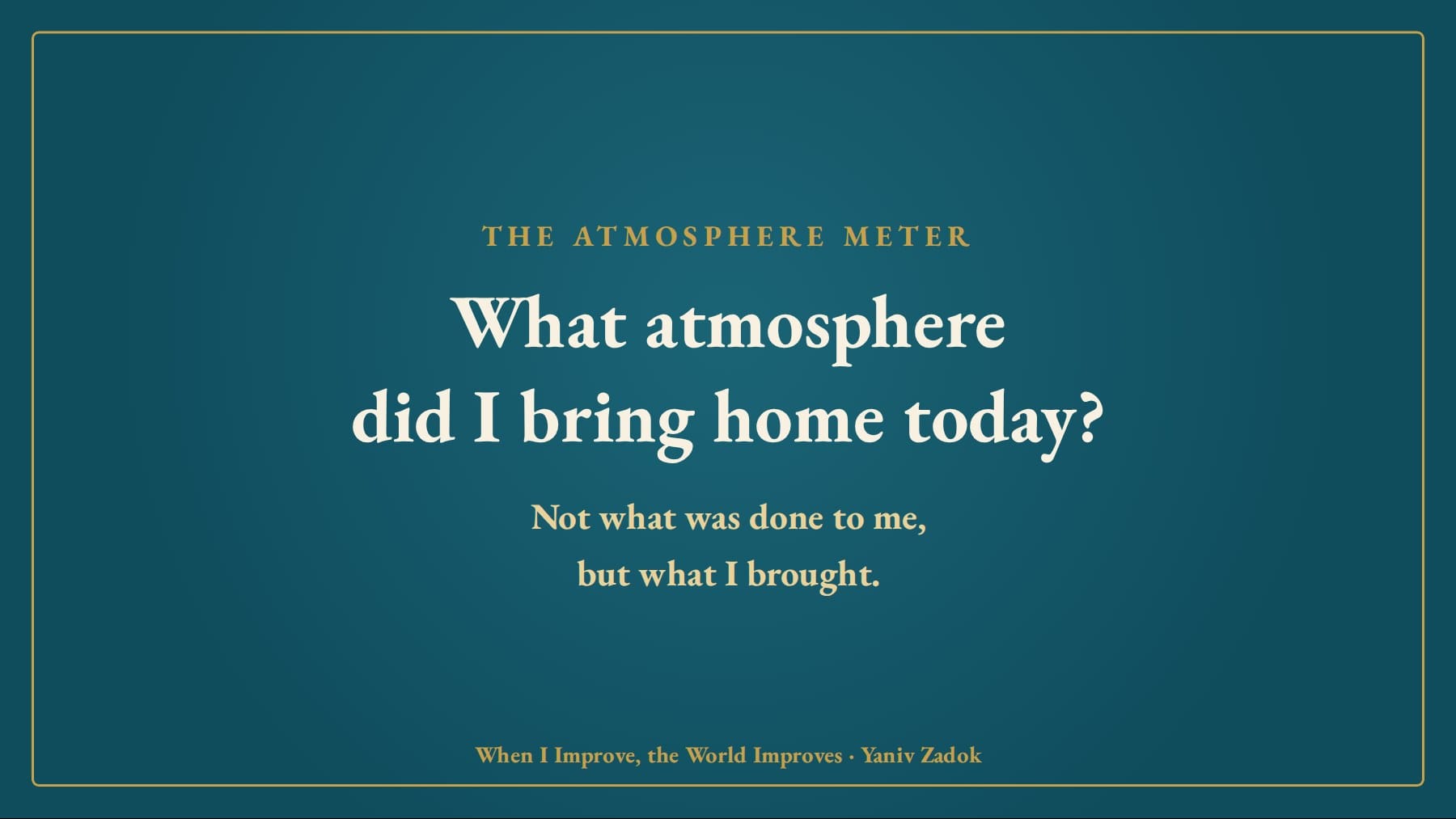
Here is a simple tool. At the end of the day, before going to sleep, ask one question: What atmosphere did I bring home today? And to work?
Not what was done to me, but what I brought.
You can even give a small score, from one to five, and write it down. After a week you already see a picture: on which days I brought calm, on which days I brought a storm, and what was different between them.
If the answer is not good, there is no need to torment yourself. Tomorrow morning is a new opportunity. But the very question already begins to change things, because whoever asks it every evening walks in differently the next day.

✨ The donkey of Pinchas ben Yair
There is something amusing and moving in this story. Even a donkey felt the righteousness of its owner.
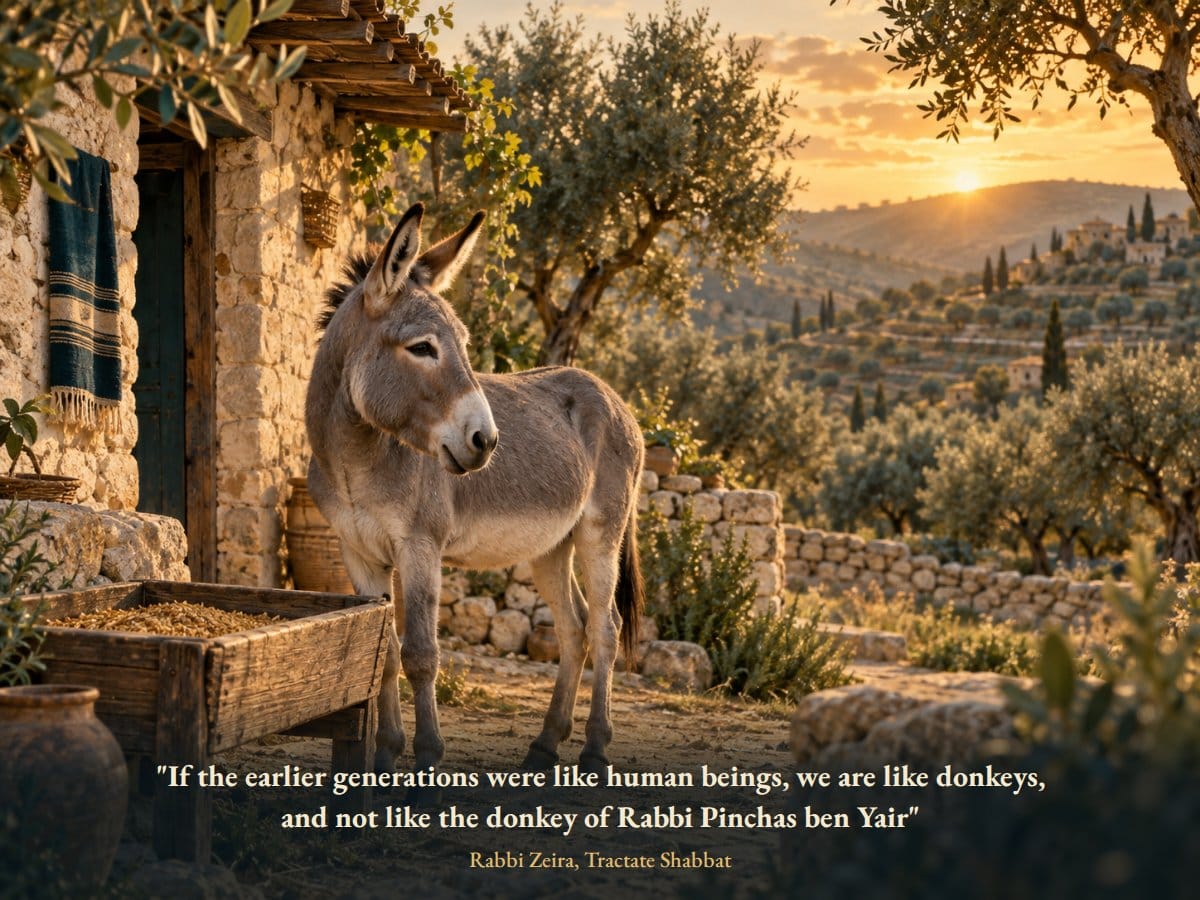
And this donkey became a parable already in the Talmud. Rabbi Zeira, one of the Talmudic sages, said with humility: "If the earlier generations were like human beings, we are like donkeys. And not like the donkey of Rabbi Pinchas ben Yair, but like ordinary donkeys."
In other words, even the sages of the Talmud looked to this donkey as an example. That is how far the righteousness of one person can seep.
If so, how much more will our children, our employees, our neighbors feel it.
We do not need to change the world. It is enough that we correct ourselves, and the world will already begin to change around us.
Good luck, and have a blessed week 🌹
Yaniv
✨ From the Great Light to the Small Deed
I was stirred to gather and draw out upright, practical ways of living from the holy writings "MiShulchan Shlomo," by our master and teacher the Yanuka, the Gaon Rabbi Shlomo Yehuda shlit"a, a hidden mystery of our generation.
Our Rabbi is great beyond measure, and we cannot grasp his greatness. And it is exactly here, in my eyes, that a great wonder lies.
From an immense depth, from the secrets of the Torah and the heights of heaven, he reveals to us the glory of the Kingship of Hashem precisely through the small, simple things of life.
One small practice, and then another small practice. One deed you can do today, and another you can add tomorrow.
What seems far, high and complicated to us, our Rabbi brings close, breaks into small steps, and gently leads us into the service of Hashem within everyday life.
Here, in the kingdom of this earth. At home, in speech, in thought, in how we treat others, and in every simple act.
And those small practices, whose greatness we sometimes barely notice, act and reach all the way to the Life of all worlds.
And from this awakening came the desire to write: each time to take one point from our Rabbi's words, to reflect on it, and to try to bring it down from learning into action.
Not to grasp the depth of his words, but to begin walking in their light.
One small step, and then another small step.
of our master and teacher the Yanuka, the Gaon
Rabbi Shlomo Yehuda shlit"a
Issue 299 · Parshat Bereshit 5787 · 4 pages, in Hebrew, ready to print
Download and print (PDF) ⬇️Send it to someone whose presence changes the atmosphere.
Share on WhatsApp 💬 💬 Send me a WhatsApp message · or visit my digital business card