 HaBeer
Paid or Not? 💸
A simple question many businesses can't answer in one place. Not for lack of a system, but because the truth about money has no single address.


📌 In this article, in a four-minute read
- Why a payment that was made shows up as "unknown", even when nobody made a mistake.
- One rule that fixes it, without buying any new system.
- Three questions to check your business this week, in five minutes.
A few weeks ago I was looking over a snapshot of the payments in the business. Next to one client, on the line for one of their payments, it said: "Unknown."
The client had paid. There was a bank transfer, there was a confirmation, an invoice had gone out. All of it existed. And yet someone who put that snapshot together in good faith wrote "unknown," and the same answer came back to me again later that day.
Now picture this happening tomorrow morning, with the client on the phone. "I just wanted to check on the last payment..." And they answer: "I paid a month ago. Didn't you get it?" No sentence erodes trust faster. Not because the mistake is big, but because of what it tells them: these people don't know what's going on with their own money.
🔍 How a right answer turns into "unknown"
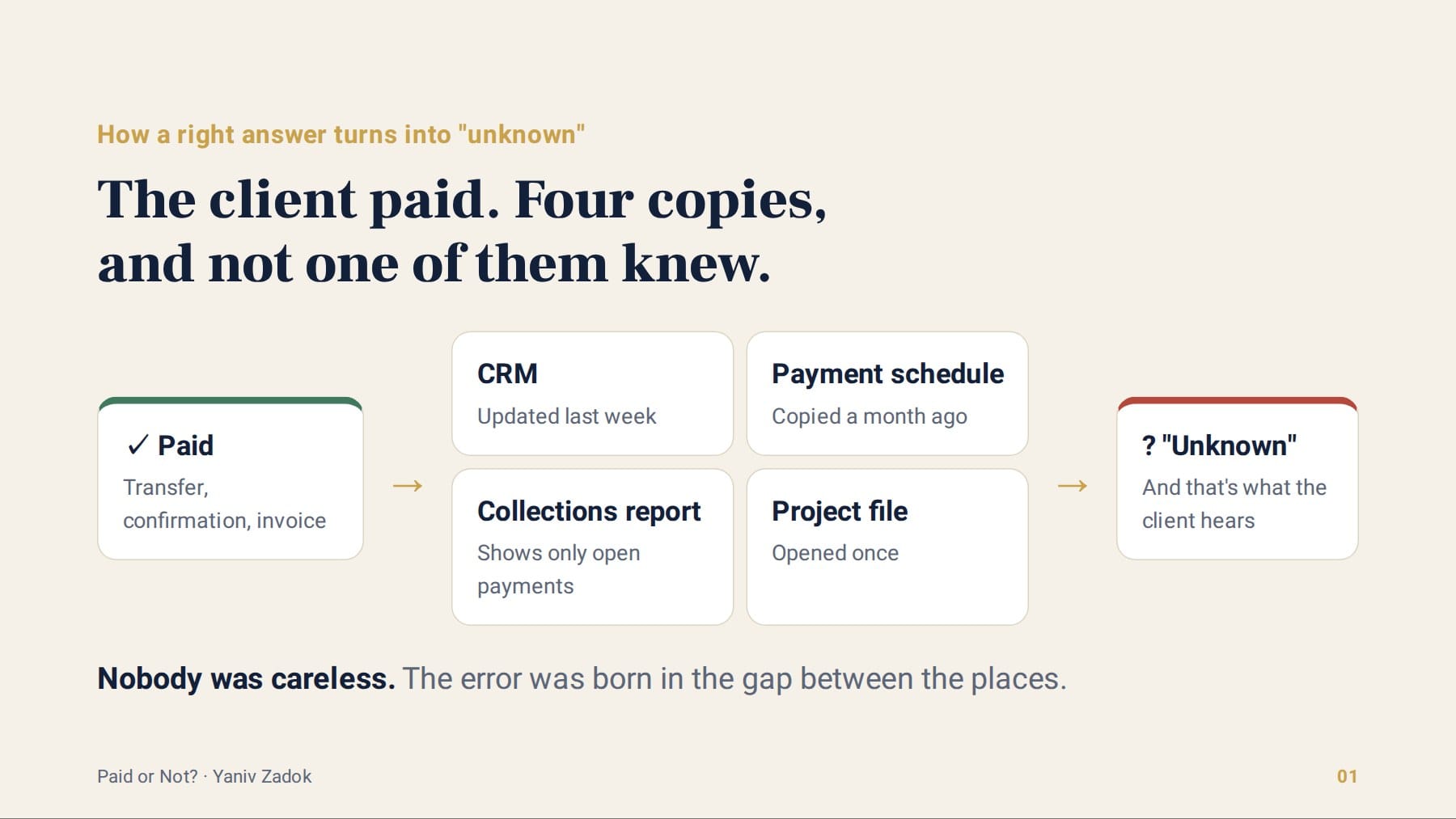
When I sat down to figure out what had happened, I found that our payment information was living in several places at once. The CRM. A spreadsheet with a payment schedule. A collections report. A tracking file someone had opened for a single project. And a few more documents, each of which had copied something from another one, on a different day.
Every one of them was correct on the day it was written. None of them was updated when the money came in.
And here's the interesting part: the collections report only listed open payments. Whoever looked up the client there found no line and concluded "unknown." But a missing line in a report of open payments doesn't mean "unknown." It means "paid." The report just can't say so out loud.
A copied report doesn't lie. It just tells you what was true on the day it was copied.
Notice that nobody here was careless. Whoever copied, copied correctly. Whoever read, read correctly. The error was born in the gap between the places, in a spot nobody is responsible for.
That's the problem with any answer that relies on a copy. A copy doesn't know the world has moved on. It holds the truth as of the day it was made, and if the question arrives after something has changed, the answer it gives will be one of two things: out of date, or "unknown." And in collections, both of them cost you money and trust.

🏠 The rule: money has one address
After that review, I set one rule for us, painfully simple:
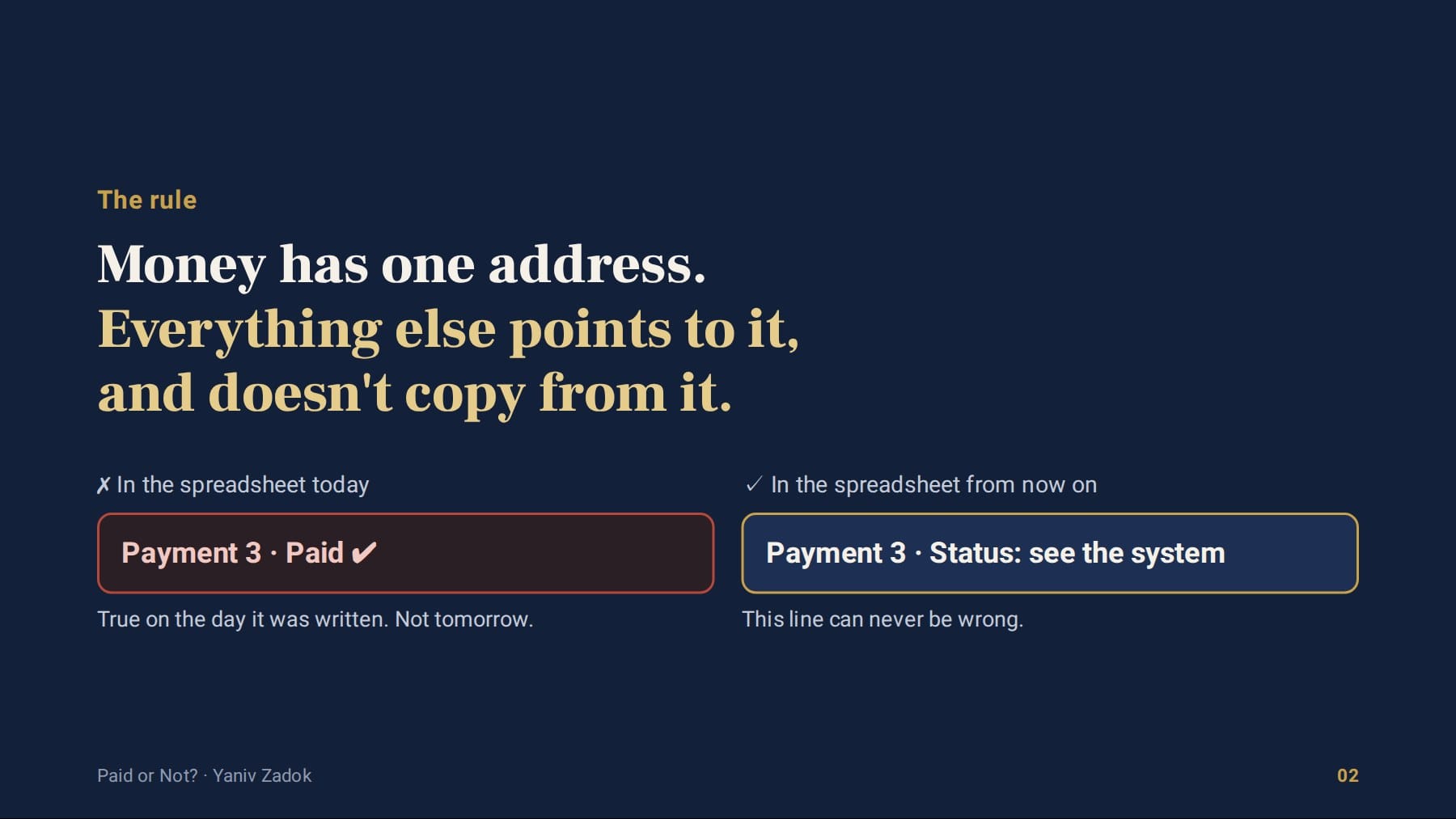
The truth about money lives in one place. Everything else points to it, and doesn't copy from it.
That doesn't mean throwing out the spreadsheet or the report. A payment schedule is a good thing. A collections report is a good thing. But neither of them keeps a status of its own. Next to a payment, they don't write "paid" or "not paid." They write where to check. The question "paid or not?" always gets answered in the same place, and nowhere else.
What does that look like in practice? In the schedule spreadsheet, next to a client's third payment, it doesn't say "Paid ✔." It says: "Status: see the system, payment 3." That looks like less information. In practice it's more truth, because that line can never be wrong. It doesn't pretend to know. It only says where the knowing happens.
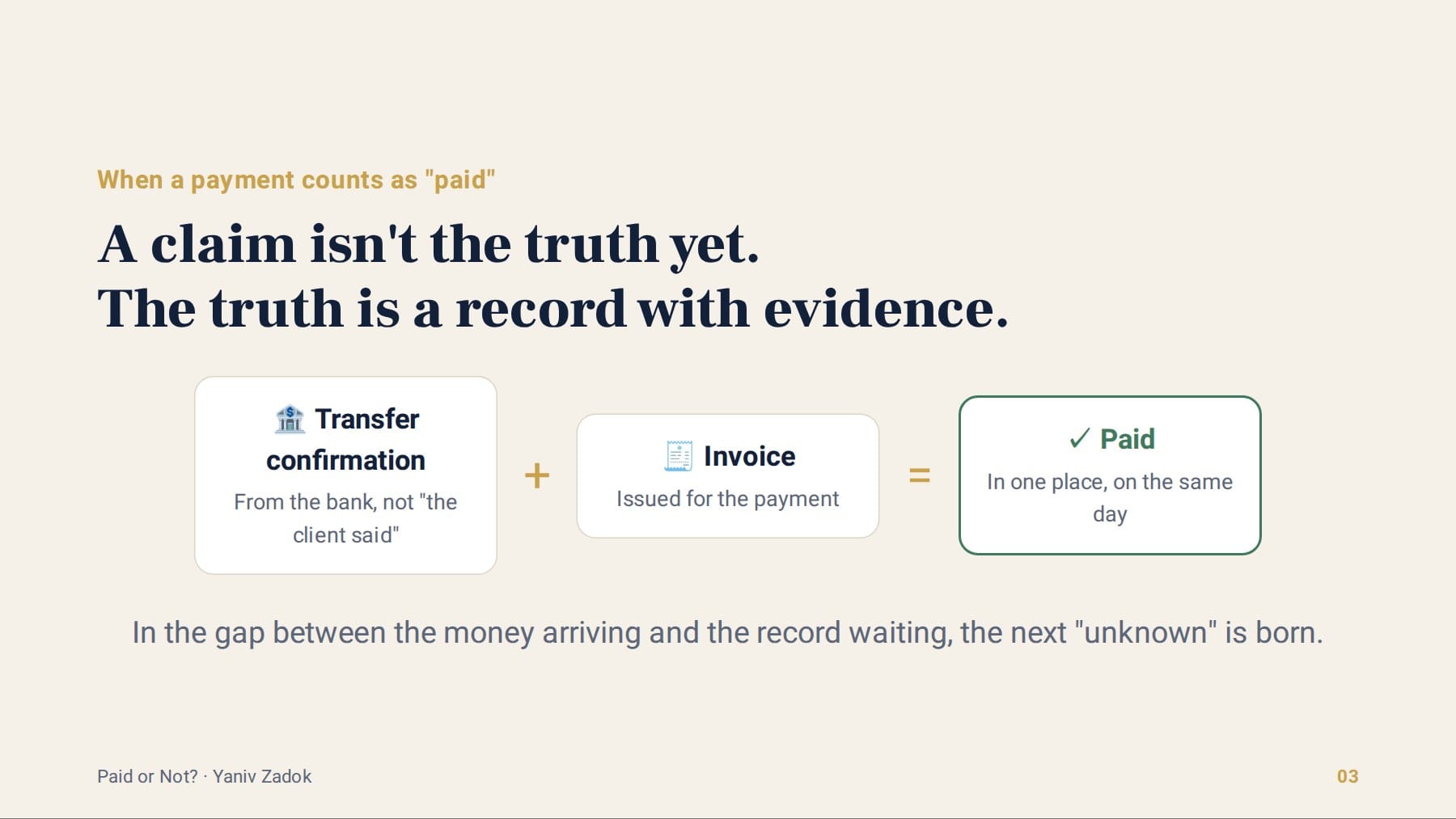
And there's a second half to the rule, the important one. For us, a payment only counts as "paid" when two things are attached to it in that one place: the transfer confirmation and the invoice. Not "the client said they sent it," and not "I think I saw it." A claim isn't the truth yet. The truth is a record with evidence.
And here's what closes the loop: the attaching happens the same day the money comes in. Not at the end of the month, not "when there's time." Because that exact gap, between the money arriving and the record waiting to be filled in, is where the next "unknown" is born.
💡 Why this isn't a software problem
A lot of business owners hear this and think: "I need a system." Not necessarily. I've seen businesses with an expensive system where the truth is still scattered, because right next to the system lives a spreadsheet everyone trusts more. And I've seen small businesses with one tidy spreadsheet that is the only address, and there the answer takes ten seconds.

The tool is secondary. What matters is the decision: where the truth lives. Once that's settled, everything else in the business can simply point to it. And when something points instead of copying, it can't go out of date.
And if your business has several people, or an AI agent that prepares reports for you, this matters twice as much. Anyone who answers a question about money needs to know where to go and check. And anyone who didn't check there doesn't answer. Not even with "unknown."
This topic is very close to a question I wrote about here, "Whose Is It?" (in Hebrew) There, the question is whose name each asset is registered under. Here, the question is where the truth about every payment is recorded. In both cases, the answer needs to be in one place that everyone knows.
✅ Three questions to ask your business this week
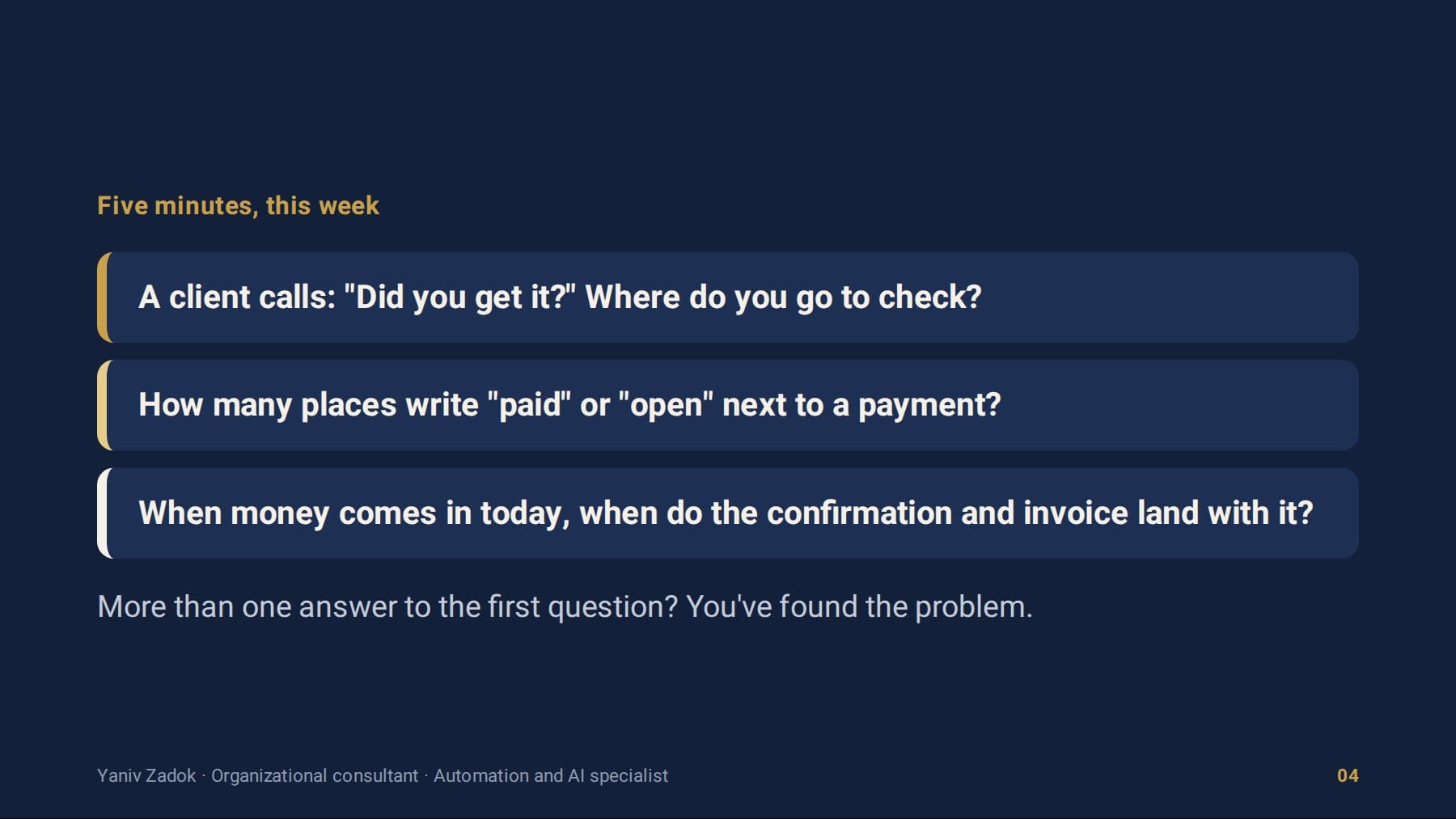
- If a client calls right now and asks, "Did you get my payment?", where do you go to check?If there's more than one answer, you've found the problem.
- How many places in your business write "paid" or "open" next to a payment?A spreadsheet, a report, WhatsApp, your own head. Each one is a copy that can go out of date.
- When money comes in today, when will the transfer confirmation and the invoice land in that same place?If the answer is "at the end of the month," the next "unknown" is already on its way.
These three questions take five minutes. And anyone who answers them honestly will know exactly where to start getting things in order.
And if, at the end of those five minutes, the answer to the first question is "depends who's checking," don't wait for the next call from a client. Pick the address today, tell everyone who works with you that this is the address, and start pointing to it. Everything else will fall into place around it. 🎯
📤 Know someone who tracks collections in a spreadsheet and on WhatsApp at the same time? Send them this article. The three questions will take them five minutes, and might spare them that next awkward phone call.

Want the truth about your money to live in one place?
I'm Yaniv. I help business owners build an organized business that doesn't depend on any one person, and bring in automation and AI only where it truly pays for itself.
Book a consultation with Yaniv 💬Or visit my digital business card