
 HaBeer
Lech Lecha: Leaving the Story You Tell About Yourself
On the first command Avraham received, on a brother who waited to see who would win, and on the land that is revealed only after you set out.


Thursday, 11 Cheshvan 5787
From "MiShulchan Shlomo" · Issue 301 · Parshat Lech Lecha

Inspired by the holy writings "MiShulchan Shlomo" (Issue 301, Parshat Lech Lecha), by our master and teacher the Yanuka, the Gaon Rabbi Shlomo Yehuda shlit"a, a hidden mystery of our generation.
Almost every one of us has a small sentence we quietly say to ourselves. "I'm just not an organized person." "With me, things always end halfway." "I'm not going to change at my age."
Nobody wrote that sentence for us. It was built slowly, from a few failures, a few remarks that stuck, a few years of habit. And over time it stops being a sentence and becomes a home. A place we live in.
This week, in Parshat Lech Lecha, the Holy One tells Avraham to leave home.
🚪 Three departures
"Go for yourself from your land, from your birthplace, and from your father's house, to the land that I will show you" (Genesis 12:1).
On the simple level, this is a geographic departure. Avraham leaves Charan, his family, everything familiar to him, and goes to a place he has not yet seen.
But the Zohar also reads this verse inward. "Lech lecha", go from this wisdom and from this watchfulness. In other words: leave the wisdom you have about yourself, the way you look at yourself and watch over yourself, and the calculations you've made about what you can and can't do.
And to where? "To the land that I will show you." To the place where it becomes clear that the One who truly watches over you is the Holy One, who looks at you every moment in order to do you good.
The first command Avraham received was not "do". It was "go out".
🌫️ The sentences that look like truth
There's a kind of wisdom that looks like realism. It tells a person: be honest with yourself. You're ruled by your habits. What you do doesn't really change anything above. And repairing the world is a matter for others, greater than you.
It sounds like humility. In practice it's darkness. Because whoever thinks this way doesn't fight at all. They don't lose the battle against the evil inclination, they simply never get to it. They've closed the discussion before it began.
And the subtle point is that these sentences don't come from outside. They sit inside the head, in the person's own voice. That's why they're so hard to recognize. They sound like "me".
Sometimes what keeps a person from the good is not the evil inclination, but the calculation they've made about themselves.
🔥 Haran, who waited to see
There's another detail in the story that's easy to miss. Why does Avraham also have to part from his brother Haran?
The Midrash tells that when Nimrod threw Avraham into the fiery furnace, Haran stood on the side and said in his heart: if Avraham wins, I'm with him. And if Nimrod wins, I'm with Nimrod. Avraham came out of the fire unharmed, and Haran declared that he was on Avraham's side. They threw him in too, and he was not saved.
Haran isn't wicked. He's simply waiting to see. He wants certainty before he commits. And that's why he stands for the place of doubt. Faith that leans on the outcome isn't faith. It's a bet.
And Avraham, to be worthy of his light, has to separate from this voice too. The voice that says: let's wait and see. If it works, then I'm in.
🗺️ The land you haven't seen yet
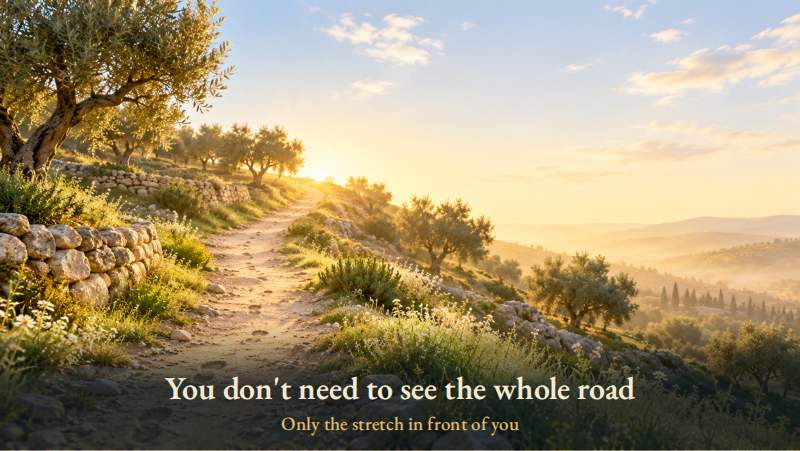
Notice the order. The Holy One doesn't show Avraham the land and then tell him to go. He tells him to go, and only afterward "I will show you".
It's the same with us. You can't see the new place from inside the old home. You can't see what I could become while I'm still standing inside the sentence "I'm just not the type who". You have to go out first, one step, and only then does the land begin to appear.
And that's also what happens to Avraham's name later in the parsha. From "Avram" he becomes "Avraham". One extra letter. As if his identity, too, doesn't stay in place, and grows along the way.
This week, choose one sentence you say to yourself about yourself, and take one small step that contradicts it. Whoever is "not an organized person" organizes one drawer. Whoever "always stops halfway" finishes one small thing all the way. One step is enough to leave home.
✨ The light waiting inside
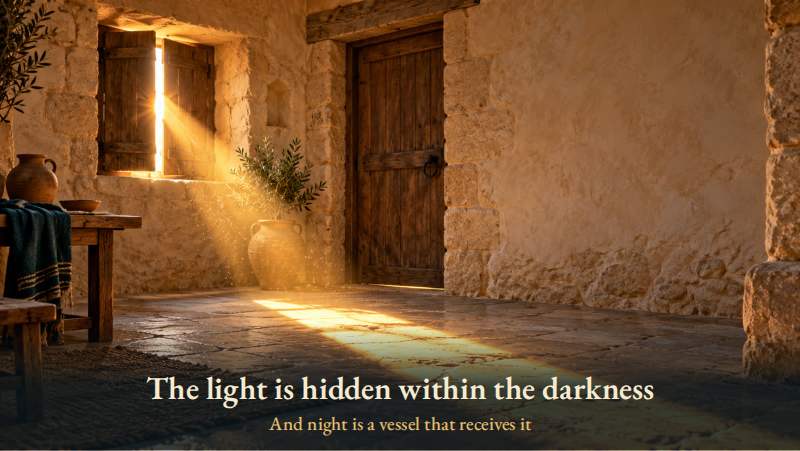
And if leaving takes strength, where does it come from? Someone sitting deep inside the old sentence, how do they even begin to walk?
There's a beautiful idea here. When the Holy One hid away the first light of creation, He didn't take it somewhere far off. He hid it inside the darkness itself. A small trace of the light remained there, and as long as that trace exists, it longs to return to its source.
That's why the Torah calls the darkness "night". It's a name for a vessel. Night isn't only the absence of day, it's a vessel that receives the light and turns it into day.
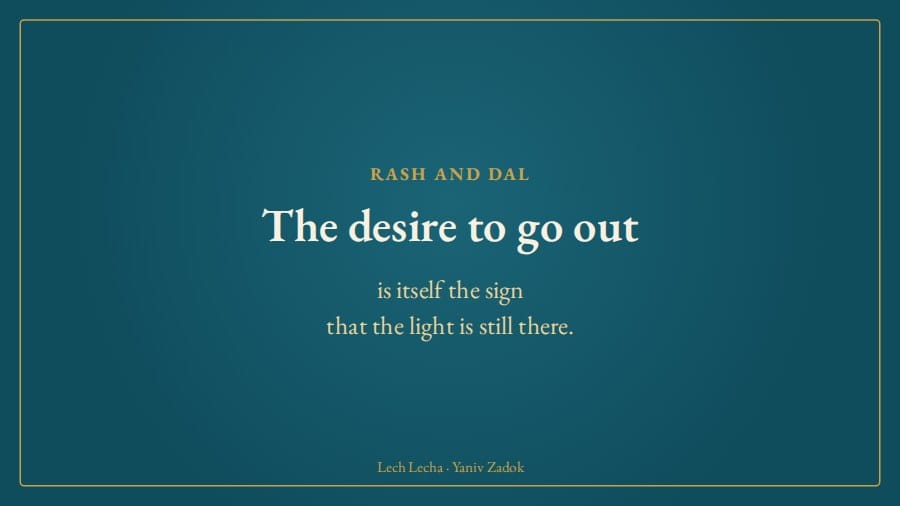
And that's the difference between two Hebrew words we tend to confuse: "rash" and "dal". A "rash" is someone who has nothing at all. A "dal" is someone who still has something in them, even something small, that can return and shine. The desire to go out is itself the sign that the light is still there.
Whoever feels that the old home has become too narrow is no longer entirely inside it. That ache isn't weakness. It's the trace of the light, asking to return.
👣 Leaving, not running away
It's important to say: "Lech lecha" is not a command to run away from yourself. Avraham doesn't run away from Charan. He goes toward something. That difference is huge.
Whoever runs away takes all the old sentences with them, just to a different place. Whoever goes leaves them at home, and sets out with an open question: what does the Holy One want to show me?
And perhaps that's why the command is phrased "lech lecha", literally "go for yourself", and not just "go". Rashi explains: for your benefit and for your good. Leaving isn't a punishment or a cutting off. It's the only way to reach who you truly are.
So my question this week: which sentence about yourself is it time to leave behind?
Have a good and blessed day 🌹
✨ From the Great Light to the Small Deed
I was stirred to gather and draw out upright, practical ways of living from the holy writings "MiShulchan Shlomo," by our master and teacher the Yanuka, the Gaon Rabbi Shlomo Yehuda shlit"a, a hidden mystery of our generation.
Our Rabbi is great beyond measure, and we cannot grasp his greatness. And it is exactly here, in my eyes, that a great wonder lies.
From an immense depth, from the secrets of the Torah and the heights of heaven, he reveals to us the glory of the Kingship of Hashem precisely through the small, simple things of life.
One small practice, and then another small practice. One deed you can do today, and another you can add tomorrow.
What seems far away, lofty and complex to us, our Rabbi brings close, breaks into small steps, and gently leads us to the service of Hashem within everyday life.
Here, in the kingdom of the earth. At home, in speech, in thought, in how we treat others, and in every simple deed.
And those small practices, whose greatness we sometimes barely notice, act and reach all the way to the Life of all worlds.
And from this awakening came the desire to write: each time to take one point from our Rabbi's words, to reflect on it, and to try to bring it down from learning into action.
Not to grasp the depth of his words, but to begin walking in their light.
One small step, and then another small step.
of our master and teacher the Yanuka, the Gaon
Rabbi Shlomo Yehuda shlit"a
Issue 301 · Parshat Lech Lecha 5787 · 4 pages, in Hebrew, ready to print
Download and print (PDF) ⬇️Send it to someone who's standing before a new beginning.
Share on WhatsApp 💬 💬 Send me a WhatsApp message · or visit my digital business card