
 HaBeer
Four to a Cubit
On a Friday table that has run out of chairs, on an office built for eight where twelve are sitting, and on one crowded bench where everyone is seen.


Sunday, 7 Cheshvan 5787
From "MiShulchan Shlomo" · Issue 300 · Parshat Noach

Inspired by the holy writings "MiShulchan Shlomo" (Issue 300, Parshat Noach) by our master and teacher the Yanuka, the Gaon Rabbi Shlomo Yehuda shlit"a, a hidden mystery of our generation.
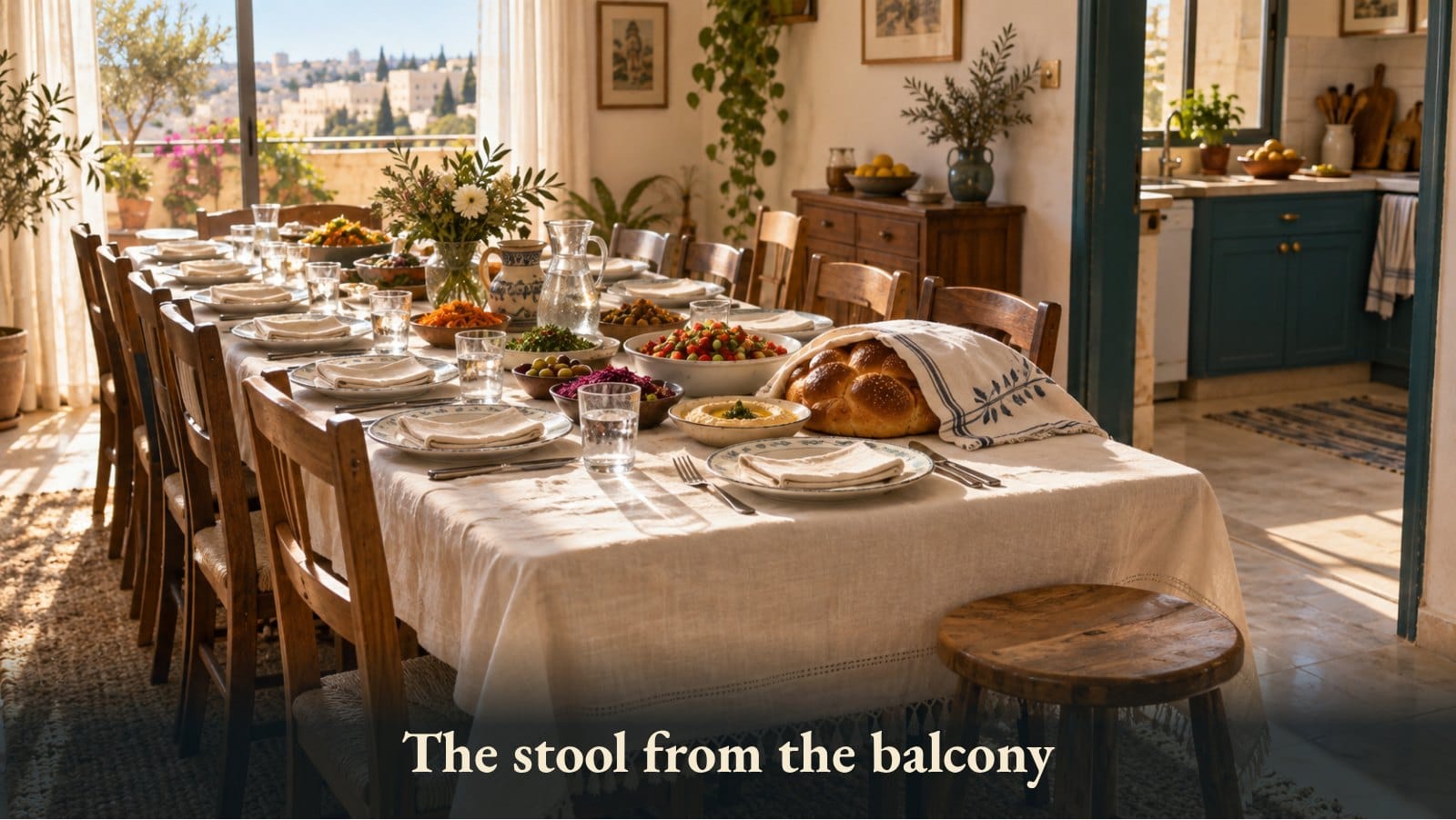
Friday at midday, and suddenly it turns out three more people are coming. The table is already full, the chairs have run out, and someone brings the stool in from the balcony. Elbows touch, the plates are crowded together, and the salad passes from hand to hand over everyone's heads.
Or an office built for eight, with twelve people working in it. Or a class of thirty-five children, where each one is looking for someone to see them.
And in crowded places like these, a quiet question comes up, one most of us know from the inside: is there room here for me too?
📏 Four to every cubit
In the Talmud, in Tractate Eruvin, Rabbi Yochanan remembers the days when he studied with Rabbi Oshaya: "When we were studying Torah with Rabbi Oshaya, we would sit four, four to a cubit." A cubit is about half a meter. In other words: four students on half a meter of bench. Shoulder to shoulder, almost on top of each other.
And right after that, the Talmud brings similar words in the name of Rabbi, about his own teacher: there they sat six to a cubit. And Rashi explains there what created such crowding: "for we would draw close to hear from his mouth, and press against one another."
The crowding did not come from a lack of space. It came from desire. Each one wanted to be a little closer, to hear one more word.
And on that same page, Rabbi Yochanan tells something else. Rabbi Oshaya had twelve students, and Rabbi Yochanan sat among them for eighteen days, and he says: "I learned the heart of each and every one, and the wisdom of each and every one."
To me, this is the most beautiful detail. A crowded bench, students pressed together, and still not one of them was swallowed up by the crowd. The crowding did not erase the person. It brought them closer.

🪑 Crowded does not mean there is no room
There are two kinds of crowding. There is the kind where everyone guards their elbows, counts how much space the neighbor took, and feels that one more person will come at their expense. And there is the crowding of people who came together because they wanted to be close.
The centimeters on the bench are the same in both. What changes is the heart of the one sitting on it.
And this is true of everyday crowding, too. A small apartment, three children in one room, a line for the shower in the morning. You can see only the squeeze in it. And you can also see in it what Rabbi Yochanan saw: people sitting close, because they belong to each other.
This, it seems to me, is how Rabbi Yochanan can be understood. He is not complaining about the crowding; he tells of it with longing. Room is not just centimeters. It is the feeling that someone is glad I am here.
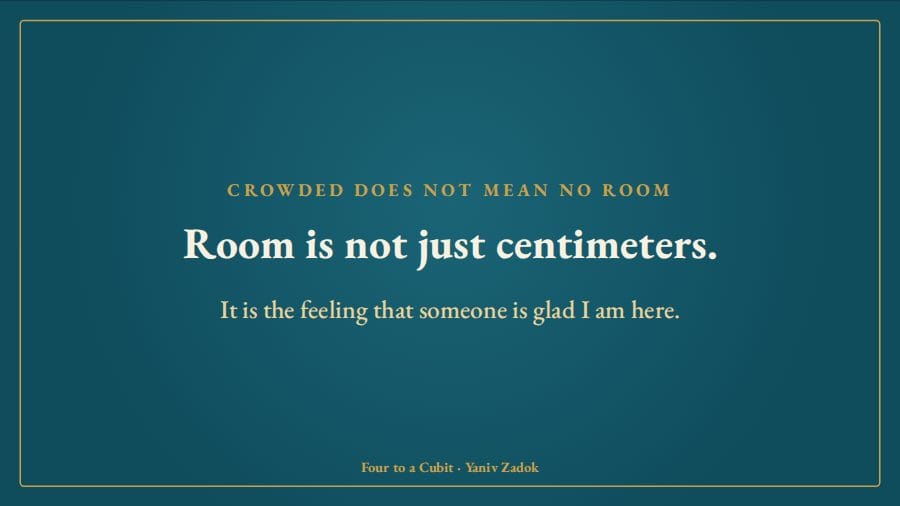
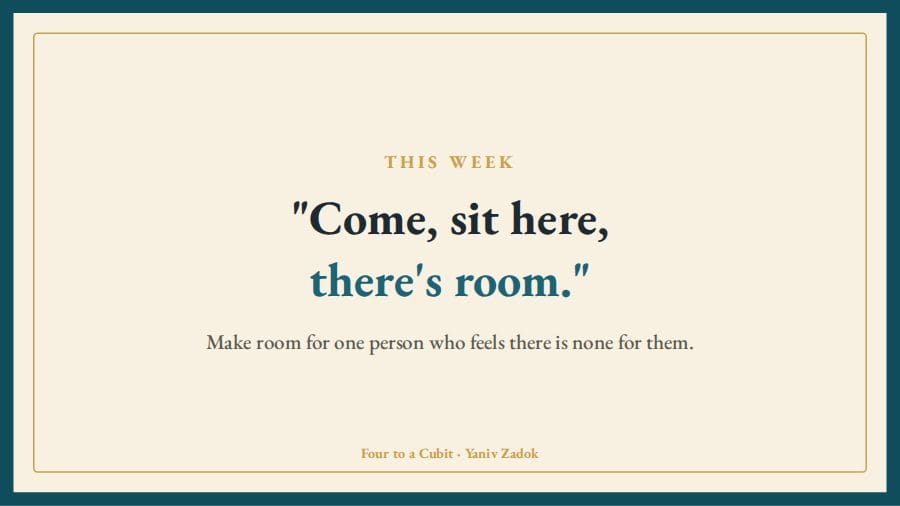
This week, make room for one person who feels there is none for them. Move a chair, call by name the one standing off to the side, or ask "what do you think?" of the one who hasn't spoken yet. Once this week, and that is enough.
🍽️ The stool from the balcony
Let's go back to the Friday table. Whoever sits on the stool, in the corner, next to the kitchen door, knows exactly where they are sitting. Even if no one meant it that way.
And sometimes one small thing is enough to turn the corner into a place: someone who moves their chair over a little and says, "Come, sit here, there's room."
It doesn't take a bigger table. It takes attention. Seeing who arrived last, who doesn't know anyone, and who is still holding their plate in their hand, looking for somewhere to put it down.
🏢 In the team meeting too
I work a great deal with management teams and with staff, and there the crowding is not always physical. Sometimes everyone sits in a spacious room, and still someone feels there is no room for them. The new employee, the one who came from another department, the one whose voice is quieter.
A manager who knows "the heart of each and every one" knows who thinks fast and who thinks deep, who needs what, and who needs to be addressed by name. They don't add room in the room. They add room in the conversation.
And sometimes it is very simple: open a meeting with a short round, where everyone says one sentence. Two minutes, and everyone in the room has already been heard once. And whoever has spoken once finds it easier to speak a second time.
🏫 And in the classroom
Parents know this too. A child comes home and says: "Nobody wanted to sit next to me." Thirty-five children in the class, and it seems to him there is no room for him.
You can tell him about Rabbi Oshaya's students. Four on half a meter of bench, and every one of them was seen.
And you can also gently ask him: is there someone else in the class who might feel like you? Sometimes the shortest way to find a place is to make room for someone else.
🙋 When I am the one looking for room
And sometimes we are not the ones moving the chair, but the ones standing with a plate in hand. Arriving at a new community, a new job, the table of a family that doesn't yet quite feel like ours.
There is something to learn from Rabbi Oshaya's bench for this, too. The students there did not wait for someone to clear a roomy spot for them. They drew close, because they wanted to hear. Sometimes the room opens up precisely when we draw a little closer: ask a question, offer to help clear the table, sit down next to someone and introduce ourselves.
And whoever remembers how it feels to stand off to the side knows, afterward, how to spot very quickly the one who is standing there now.

🌿 One more on the bench
We are used to thinking of room as a limited resource. One more inside, less for everyone else. But on Rabbi Oshaya's bench it worked the other way around. Everyone who joined brought with them another heart and more wisdom, and Rabbi Yochanan learned from all of them.
The bench did not grow. What grew was the heart of those sitting on it.
At a table with an open heart, there is always room for one more.
So my question this week: who is near you, still waiting for someone to tell them "there's room"?
Have a good and blessed day 🌹
✨ From the Great Light to the Small Deed
I was stirred to gather and draw out upright, practical ways of living from the holy writings "MiShulchan Shlomo," by our master and teacher the Yanuka, the Gaon Rabbi Shlomo Yehuda shlit"a, a hidden mystery of our generation.
Our Rabbi is great beyond measure, and we cannot grasp his greatness. And it is exactly here, in my eyes, that a great wonder lies.
From an immense depth, from the secrets of the Torah and the heights of heaven, he reveals to us the glory of the Kingship of Hashem precisely through the small, simple things of life.
One small practice, and then another small practice. One deed you can do today, and another you can add tomorrow.
What seems far, high and complicated to us, our Rabbi brings close, breaks into small steps, and gently leads us into the service of Hashem within everyday life.
Here, in the kingdom of this earth. At home, in speech, in thought, in how we treat others, and in every simple act.
And those small practices, whose greatness we sometimes barely notice, act and reach all the way to the Life of all worlds.
And from this awakening came the desire to write: each time to take one point from our Rabbi's words, to reflect on it, and to try to bring it down from learning into action.
Not to grasp the depth of his words, but to begin walking in their light.
One small step, and then another small step.
of our master and teacher the Yanuka, the Gaon
Rabbi Shlomo Yehuda shlit"a
Issue 300 · Parshat Noach 5787 · 4 pages, in Hebrew, ready to print
Download and print (PDF) ⬇️Send it to someone who always makes sure there is room for one more.
Share on WhatsApp 💬 💬 Send me a WhatsApp message · or visit my digital business card